
A medical practice can publish excellent articles and still struggle to attract qualified website traffic.
The problem is often not a lack of content. It is a lack of connection between the content.
A physician’s website may contain service pages, provider biographies, patient guides, location pages, Google review articles, and appointment information. But when those pages operate independently, patients may not know where to go next. Search engines may also have less context about how the pages relate.

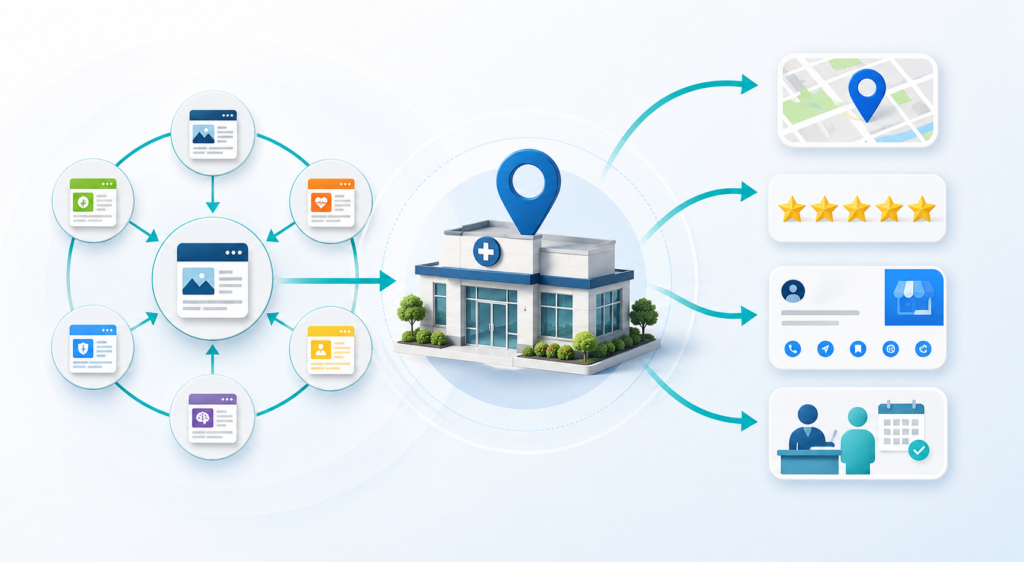
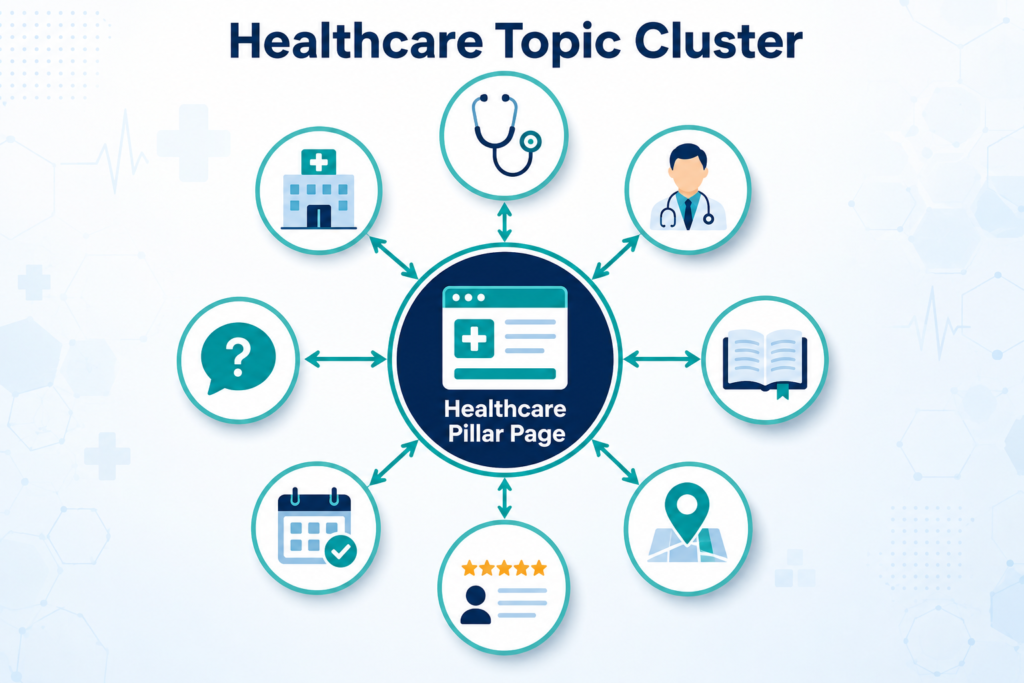
Healthcare topic clusters solve this problem by organizing related pages around one central subject. A comprehensive pillar page introduces the topic, supporting articles answer narrower questions, and internal links guide readers between the resources.
For an NYC medical practice, nursing home, rehabilitation center, chiropractor, dentist, home-health organization, or assisted-living facility, a well-planned cluster can support more than SEO. It can help patients and families:
- Find answers to specific questions
- Understand available services
- Compare local options
- Evaluate providers and facilities
- Review trust signals
- Request an appointment, consultation, tour, or assessment
The goal is not simply to create more pages. The goal is to build a useful path from a healthcare question to an appropriate next step.
What Is a Healthcare Topic Cluster?
A healthcare topic cluster is a group of related website pages organized around one central healthcare subject. A pillar page provides a broad overview, cluster articles answer specific patient or administrator questions, and internal links connect the pages into a clear information path.
For example, a pillar page about Google Review Management for Medical Practices could connect to articles about review requests, Google policies, review responses, Google Maps visibility, staff training, and patient trust.
This structure can help:
- Patients and families find related information
- Healthcare websites cover a subject more completely
- Search engines discover and understand connected pages
- Informational visitors reach service and conversion pages
- Practices attract traffic from more specific searches
Topic clusters do not guarantee rankings. Their value comes from organizing helpful, original content around real audience needs and making important pages easier to find.
Why Disconnected Healthcare Content Loses Opportunities
Many healthcare websites publish content one article at a time without deciding how each article supports the patient journey or the organization’s business goals.
This can produce several problems:
- Articles compete with one another for similar keywords
- Important service pages receive few internal links
- Readers reach an informational article but never see the related service
- Location pages fail to connect with provider or treatment pages
- Google review content remains separate from Local SEO content
- Older articles become difficult to find
- Calls to action lead to unrelated offers
Imagine that a Queens family practice has separate articles about Google reviews, Google Maps, physician reputation, appointment scheduling, and Local SEO.
Each article may be useful, but the practice is missing an opportunity if those pages do not guide readers to one central medical-practice resource.
A topic cluster gives every important page a defined role. It also helps a healthcare organization decide what content is missing, what content overlaps, and which page should lead readers toward a consultation, appointment, tour, or audit.
Build Healthcare Clusters Around Search Intent
Search Intent is the reason behind a search. Patients, families, and healthcare administrators may use similar words while expecting very different answers.
| Search Intent | Example search | Best page type |
|---|---|---|
| Informational | How many Google reviews should a doctor have? | Educational article |
| Local | Family doctor in Queens | Service and location page |
| Comparison | Best-rated nursing homes in Brooklyn | Trust and comparison resource |
| Reputation | Dr. Smith reviews | Provider and reputation page |
| Transactional | Book a chiropractor in Queens | Appointment page |
| Administrative | How should a nursing home respond to reviews? | Administrator guide |
A strong healthcare cluster contains content for several stages without forcing every visitor onto the same page.
Someone asking a general question may not be ready to schedule. The article should answer the question first and then offer a relevant next step.
Someone searching for an appointment should reach a page with a visible phone number, booking option, location, and provider information.
Matching content to Search Intent attracts more relevant visitors and creates a smoother path from discovery to action.
The Three Parts of a Healthcare Topic Cluster
1. The Pillar Page
The pillar page is the central resource. It introduces a broad subject, answers the most important questions, and links to deeper articles.
A pillar page should be broad enough to support several subtopics but focused enough to serve one identifiable audience.
“Digital Marketing” is too broad for a healthcare campaign. “Google Review Management for Medical Practices” is more specific and commercially relevant.
2. Cluster Content
Cluster content answers narrower questions related to the pillar topic. Each article should provide value on its own while leading readers toward other helpful resources.
Examples include:
- Google review policy guides
- Medical-office staff checklists
- Google Maps articles
- Review-response guides
- Reputation calculators
- Local healthcare studies
3. Internal Links
Internal links connect the pillar and cluster pages. They help readers discover related information and help search engines find pages and understand their context.
Use descriptive anchor text such as “Google review management for medical practices” instead of vague phrases such as “click here.”

Add links where they genuinely help the reader rather than trying to reach a fixed number.
Example: Google Review Management Cluster for Medical Practices
A healthcare content strategy can be organized around a Google Review Management pillar page supported by practical cluster content.
| Content role | Recommended page |
|---|---|
| Pillar page | Google Review Management for Medical Practices |
| Cluster article | How Many Google Reviews Should a Medical Practice Have? |
| Cluster article | How to Request Patient Reviews Without Breaking Google’s Rules |
| Cluster article | Why Your Medical Practice Isn’t Ranking in Google Maps |
| Cluster article | How Medical Practices Should Respond to Google Reviews |
| Cluster article | Medical Office Staff Training Checklist for Better Reviews |
| Cluster article | How Google Maps Helps Medical Offices Get More Patients |
| Cluster article | Patients Compare Family Doctors on Google First |
| Interactive resource | Google Review Goal Calculator |
| Conversion page | Free Medical Practice Google Review Audit |
The pillar page should introduce each subject and link to the detailed resource. Every cluster article should link back to the pillar page using natural, descriptive language.
Related articles may also link to one another.
An article about Google Maps visibility could naturally link to the guide explaining how many reviews a medical practice should have. A staff-training checklist could link to the review-request guide.
The audit page serves as the conversion destination. It gives administrators who recognize a problem a clear next step without turning every educational paragraph into a sales pitch.

Example: Nursing Home Reputation and Admissions Cluster
The same topic-cluster strategy can support a nursing home, rehabilitation center, assisted-living community, or other facility where families and referral partners evaluate trust before making contact.
| Content role | Recommended page |
|---|---|
| Pillar page | Google Review Management for NYC Nursing Homes |
| Cluster article | How Negative Google Reviews Can Reduce Nursing Home Occupancy |
| Cluster article | What Families Examine Before Choosing a Nursing Home |
| Cluster article | How Nursing Homes Should Respond to Google Reviews |
| Cluster article | Why Family Doctors May Refer Patients Elsewhere |
| Cluster article | Google Review Monitoring for NYC Nursing Homes |
| Cluster article | How Recent Reviews Affect Family Trust |
| Interactive resource | Nursing Home Review Gap Assessment |
| Conversion page | Free Nursing Home Reputation Assessment |
This cluster should focus on the outcomes that matter to administrators, admissions leaders, executive directors, and community-relations teams:
- Family trust
- Referral confidence
- More qualified inquiries
- Tour requests
- Admissions opportunities
- Recurring service themes
- Professional responses
The articles should not promise that reviews automatically increase occupancy. They should explain how online reputation can influence whether a facility makes a family’s shortlist and receives an inquiry.
The Lookhin4 CARE Healthcare Content Cluster Framework
Lookhin4 uses the CARE framework to evaluate whether a healthcare content cluster supports visibility, trust, and action.
| CARE element | What it means | What to evaluate |
|---|---|---|
| C — Core question | One central patient, family, or administrator problem | Is the pillar topic clear and commercially relevant? |
| A — Audience and local intent | A defined healthcare audience and location | Does the content reflect real NYC services, boroughs, and decision-makers? |
| R — Related resources and reputation | Supporting pages, reviews, and trust signals | Do cluster pages answer distinct questions and connect naturally? |
| E — Engagement and next step | A useful conversion path | Can readers request an audit, appointment, tour, or consultation? |
C — Core Question
Start with one problem that your organization can address comprehensively.
Examples include earning authentic Google reviews, improving Google Maps visibility, helping families compare facilities, or attracting patients to a specific medical service.
A — Audience and Local Intent
Identify who needs the information and where the service is available.
A Queens physician campaign should reflect Queens patients and neighborhoods. A nursing-home campaign may address families, hospital discharge planners, administrators, and referral partners across NYC.
R — Related Resources and Reputation
Create supporting pages that answer different questions instead of publishing near-duplicates.
Connect educational content with provider credentials, facility information, authentic reviews, Google Business Profile guidance, and relevant service pages.
E — Engagement and Next Step
Every cluster needs a sensible conversion path.
Informational readers may be offered a checklist or audit. Readers with an immediate need may be ready to call, schedule, request a tour, or book a consultation.
How to Build a Healthcare Topic Cluster Step by Step
Step 1: Select One Business Goal
Choose a measurable goal such as attracting qualified appointment requests, increasing nursing-home inquiries, growing audit requests, or improving discovery of a specific service.
Step 2: Choose the Pillar Topic
Select a subject that connects audience needs with a service your organization actually provides. Avoid topics that are so broad that they cannot support a clear conversion path.
Step 3: Research Real Questions
Use Google Search Console, Google Business Profile interactions, staff questions, review themes, consultation calls, and keyword research to understand what people need to know.
Step 4: Group Questions by Search Intent
Separate informational, local, comparison, reputation, and transactional questions. This prevents one page from trying to satisfy every visitor.
Step 5: Audit Existing Content
Identify pages that already cover the subject. Decide whether to keep, update, combine, redirect, or remove overlapping content before creating more articles.
Step 6: Create Missing Resources
Build the pages that fill real gaps. Prioritize quality, usefulness, and firsthand healthcare context over publishing frequency.
Step 7: Connect the Pages
Link the pillar page to its cluster content, link every cluster article back to the pillar, and connect related cluster pages where the link improves the reader’s journey.
Step 8: Add the Right Conversion Path
Healthcare topic clusters organize related content around one main service or concern. Medical practices, nursing homes, rehabilitation centers, and assisted-living communities can answer questions about care, insurance, admissions, reviews, and locations. This structure improves search visibility, builds trust, and guides patients and families from research to scheduling or contacting the organization.

Step 9: Measure Performance
Track impressions, clicks, calls, forms, audit requests, booking actions, tour requests, and other meaningful outcomes.
Step 10: Update the Cluster
Review important pages regularly. Correct outdated information, repair broken links, improve underperforming pages, and add new cluster content when audience needs change.
How to Link Healthcare Cluster Pages Correctly
Internal links are the structure that holds the cluster together.
Use these rules:
- Link every important cluster article to its pillar page.
- Link the pillar page to every important cluster article.
- Link between cluster articles when the next resource helps the reader.
- Use concise, descriptive anchor text.
- Link informational articles to an appropriate service, audit, calculator, or consultation.
- Check for broken links and pages with no internal links.
- Avoid inserting irrelevant links simply to influence rankings.
For example:
“Practices that need a consistent process can review our guide to Google Review Management for Medical Practices.”
The descriptive anchor tells the reader what to expect. It is more useful than “learn more” or “click here.”
Google states that internal links and their anchor text can help people and Google make sense of a website and discover other pages. Google also says there is no magical ideal number of links. Use the number that genuinely helps visitors navigate the topic.
Read Google’s official internal-link recommendations.

Connect Topic Clusters With Local SEO and Google Reviews
Website content helps answer questions, but local patients and families may discover a healthcare organization through Google Maps before visiting the website.

That means the topic cluster should support—not replace—the organization’s local presence.
A complete healthcare visibility system connects:
- Helpful educational content
- Service and treatment pages
- Provider or facility profiles
- Accurate location pages
- An optimized Google Business Profile
- Authentic Google reviews
- Professional, privacy-conscious responses
- Clear appointment, inquiry, or tour options
Google explains that local results are mainly based on relevance, distance, and prominence. Complete business information, website references, links, reviews, and positive ratings can contribute to how a business appears locally.
Topic clusters primarily strengthen the website’s organization and usefulness. Google reviews help patients and families evaluate trust. Local SEO connects the organization with nearby searches.
These elements work best as one coordinated strategy.
Read Google’s explanation of local ranking factors.
Create Healthcare Content Worth Finding and Citing
Publishing more articles does not automatically produce more authority.
Generic pages that repeat information found everywhere else give readers—and AI search tools—little reason to cite your website.
Healthcare cluster content should add something useful and identifiable, such as:
- Original local research
- A clearly explained methodology
- A named Lookhin4 framework
- An administrator checklist
- A medical-practice review calculator
- A Queens neighborhood comparison
- A nursing-home reputation study
- Firsthand observations from audits
- Current primary sources
- Clear author credentials
For example, Lookhin4 could evaluate 25 Queens medical practices using consistent criteria such as:
- Average rating
- Review count
- Review recency
- Response activity
- Appointment links
- Google Business Profile completeness
Publishing the criteria, date checked, limitations, and findings would create a more original and citable resource than another general list of SEO tips.
Google recommends helpful, reliable, people-first content that provides original information, research, analysis, or substantial additional value.
Read Google’s people-first content guidance.
How to Measure Whether a Healthcare Cluster Is Working
Do not judge the cluster using traffic alone.
| Metric | What it helps evaluate |
|---|---|
| Search impressions | Whether pages are gaining visibility |
| Organic clicks | Whether searchers visit the website |
| Search queries | Whether pages match relevant audience needs |
| Landing-page traffic | Which cluster pages attract visitors |
| Internal-link clicks | Whether readers explore related resources |
| Calls | Whether visitors take a direct action |
| Appointment clicks | Whether medical-practice traffic moves toward booking |
| Audit requests | Whether reputation content produces leads |
| Tour or inquiry requests | Whether facility content supports admissions opportunities |
| Review activity | Whether the online reputation remains current |
| Conversion rate | Whether qualified traffic produces meaningful actions |
Use Google Search Console to review queries, impressions, clicks, and pages.
Combine that information with website analytics, call tracking, booking data, form submissions, and Google Business Profile performance.
A page can generate less traffic than a general article and still be more valuable if its visitors are qualified and take action.
Common Healthcare Topic Cluster Mistakes
Choosing a Topic That Is Too Broad
“Healthcare marketing” is too wide to guide one focused cluster. Choose a more specific problem, audience, or service.
Creating Near-Duplicate Location Pages
Do not copy the same page for every NYC borough or neighborhood and replace only the location name. Each location page should contain distinct, useful information.
Writing for Keywords Instead of People
Use the language patients, families, and administrators use, but avoid keyword stuffing and awkward repetition.
Publishing Without a Conversion Path
Readers should have a relevant next step, such as another guide, calculator, audit, appointment, tour, or consultation.
Linking Every Page to Everything
Too many unrelated links create clutter. Link when the destination helps answer the reader’s next question.
Making Unsupported Healthcare Claims
Avoid guaranteed outcomes, invented statistics, or statements that imply reviews automatically produce rankings, patients, or admissions.
Ignoring Existing Content
Review older pages before creating new ones. Updating or combining existing content may be better than adding another overlapping article.
Forgetting Mobile Visitors
Patients and families frequently search while using a phone. Test Page Speed, navigation, phone links, forms, and appointment buttons.
Frequently Asked Questions

Do topic clusters guarantee higher Google rankings?
No. Topic clusters can improve content organization, internal linking, and navigation, but they do not guarantee rankings. Content quality, relevance, competition, technical SEO, local factors, and other signals also matter.
How many articles should a healthcare topic cluster include?
There is no required number. Start with a strong pillar page and the supporting articles needed to answer the audience’s most important questions. Add content when it provides distinct value.
Should every cluster article link to a service page?
Every article should have a relevant next step, but that step does not always have to be a service page. It may be another educational resource, checklist, calculator, audit, appointment page, or consultation.
Can topic clusters help a Queens medical practice attract patients?
They can help a practice create useful pages for specific services, patient questions, providers, and Queens locations. When combined with Local SEO, Google reviews, and clear appointment paths, those pages can attract more qualified search traffic and inquiries.
Can nursing homes use topic clusters?
Yes. Nursing homes can organize content around family trust, admissions questions, Google reviews, referral relationships, facility comparisons, services, and location information.
How often should healthcare cluster content be updated?
Review performance and essential information regularly. A quarterly content audit is a practical starting point. Provider, service, location, policy, or contact changes should be corrected as soon as they occur.
How does Google Search Console help?
Search Console shows queries, impressions, clicks, pages, and other information about Google Search performance. It can reveal which cluster pages are gaining visibility and which may need improvement.
Can Lookhin4 build a healthcare content cluster?
Lookhin4 helps healthcare organizations connect Google Review Management, Local SEO, Google Business Profile optimization, patient-focused website content, internal linking, and performance monitoring into a coordinated visibility strategy.
Build a Healthcare Content System, Not a Collection of Articles
Healthcare topic clusters are not simply groups of blog posts.
They are structured information paths that help patients, families, administrators, and referral partners move from a question to a trusted answer—and from that answer to an appropriate next step.
The strongest clusters begin with one clear audience problem. A pillar page introduces the subject, supporting content answers specific questions, and internal links connect the journey.

Related Articles
- Why Your Medical Practice Isn’t Ranking in Google Maps
- How Google Maps Helps Medical Offices Get More Patients
- How Many Google Reviews Should a Medical Practice Have?
- Patients Compare Family Doctors on Google First—Is Your Queens Practice Ready?
- Medical Office Staff Training Checklist for Better Reviews
- How Negative Google Reviews Can Reduce Nursing Home Occupancy
- Google Review Strategy for Chiropractors That Drives Growth
- SEO Service Page Optimization Checklist