
Can Negative Google Reviews Damage a Healthcare Organization?
A sudden wave of negative Google reviews can seriously damage the reputation of a nursing home or medical practice.
Families researching nursing homes often compare ratings, recent reviews, management responses, photographs, and overall review activity before scheduling a tour. Patients may perform the same research before choosing a physician, specialist, or medical office.
When they encounter accusations, spam, fake reviews, personal attacks, or repeated one-star ratings, they may move on without calling.
A professional Google removal service can help a healthcare organization determine whether harmful reviews violate Google’s policies and may qualify for removal. However, a legitimate Google removal service should never promise that every negative review can be deleted.
Google—not the medical practice, nursing home, marketing agency, or reputation company—makes the final removal decision.
What Is a Google Removal Service?
A Google removal service helps an organization analyze, document, report, and monitor Google reviews that may violate Google Maps content policies.
For nursing homes and medical practices, a Google removal service may provide:
- Review-policy analysis
- Fake-review identification
- Evidence collection
- Review reporting assistance
- Removal-status monitoring
- Appeal support when available
- Professional response recommendations
- Ongoing reputation monitoring
- Google Business Profile assistance
- Healthcare reputation recovery planning
The purpose of a Google removal service is not to hide every complaint or silence dissatisfied patients and families. Its purpose is to identify content that may violate Google’s rules and use the proper reporting process.
A responsible Google removal service should also help the healthcare organization address legitimate complaints that do not qualify for removal.
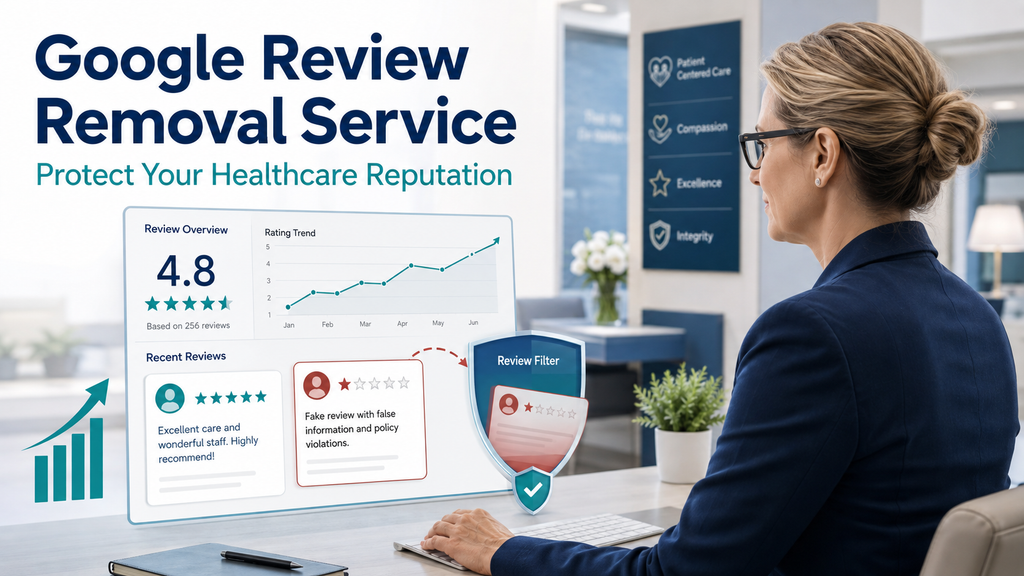
Can Nursing Homes and Medical Practices Remove Every Negative Review?
No. A Google removal service cannot remove a review simply because it is negative, embarrassing, unfair, or damaging to the organization’s reputation.
Google states that businesses should not report reviews merely because they disagree with them. A review generally must violate an applicable Google policy before Google will consider removing it.
Potential violations may include:
- Fake engagement
- Reviews that do not reflect a genuine experience
- Spam or repetitive content
- Competitor or employee conflicts of interest
- Impersonation
- Harassment
- Hate speech
- Obscene or profane content
- Certain personal information
- Misleading or deceptive content
- Off-topic promotional material
- Incentivized or manipulated reviews
Google’s policies prohibit fake engagement and certain forms of rating manipulation. Google also provides a reporting process, status tool, and—in eligible cases—a one-time appeal. Review Google’s current prohibited and restricted content policies and its instructions for reporting inappropriate reviews before submitting a request.
A trustworthy Google removal service should evaluate each review individually instead of reporting every negative comment.
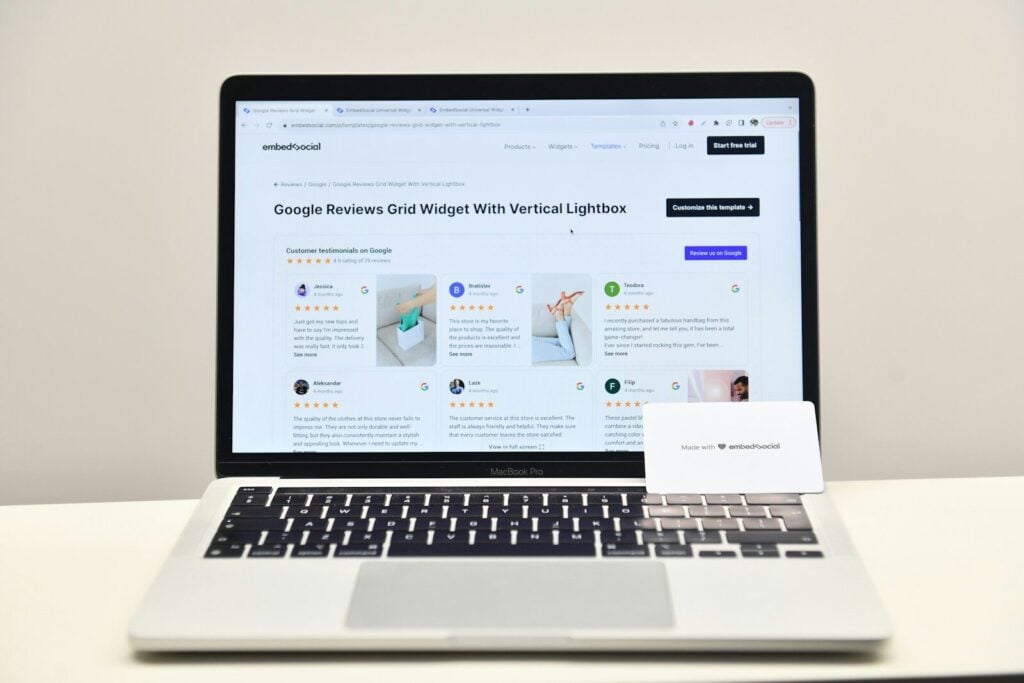
Why Healthcare Reviews Require Special Attention
Online reviews can be especially complicated for medical practices and nursing homes.
A medical office must consider patient privacy when responding. A nursing home may receive reviews from residents, relatives, visitors, employees, former employees, vendors, or people who claim to know about an incident.
Even when the reviewer openly discusses a patient or resident, the organization should not publicly confirm that person’s identity, treatment, diagnosis, residency, or relationship with the facility.
A healthcare-focused Google removal service should understand that a public response cannot become a debate about private medical information.
The response should remain general, calm, and professional. When appropriate, it can invite the reviewer to contact an authorized administrator privately.
Because privacy and legal requirements depend on the circumstances, healthcare organizations should have sensitive responses reviewed by their compliance or legal professionals.
When Can a Google Removal Service Help a Nursing Home?
A Google removal service may help a nursing home when its Google Business Profile receives suspicious or policy-violating reviews.
Examples may include:
- Several one-star reviews appearing within a short period
- Reviews from accounts with no apparent connection to the facility
- Former employees posting content connected to an employment dispute
- A competing organization attempting to undermine the facility
- Duplicate reviews posted across multiple accounts
- Reviews containing threats, harassment, or prohibited personal information
- Reviews discussing a different nursing home
- Coordinated rating manipulation
- Reviews containing spam or unrelated advertisements
- Review extortion or demands for money, services, or concessions
A Google removal service can document the pattern, compare the content with Google’s policies, and select the most relevant reporting reason.
However, a nursing home should not assume that every review from a person missing from the resident database is fake. Family members, visitors, prospective residents, and other people may have genuine experiences with the facility.
That is why careful analysis is essential.
When Can a Google Removal Service Help a Medical Practice?
A Google removal service may also help a physician, dental office, clinic, or medical practice respond to suspicious reviews.
Possible examples include:
- A review posted for the wrong physician
- A complaint about a medical office at another location
- Reviews copied and posted repeatedly
- A competitor attempting to damage the practice
- A review containing discriminatory attacks
- Spam unrelated to the medical practice
- A reviewer impersonating another person
- Prohibited disclosure of personal information
- A sudden pattern of suspicious one-star ratings
- A review containing threats or harassment
A Google removal service can organize the available facts and report a suspected violation through the correct channel.
The Google removal service should not argue that a review must be false merely because the reviewer used a different Google name than the name in the practice’s system. People may use nicknames, married names, family accounts, or other identifiers.
Removal requests should be based on the content and Google’s policies—not unsupported assumptions.
How a Google Removal Service Works
A professional Google removal service should follow a clear, policy-based process.
1. Audit the Complete Review Profile
The Google removal service begins by reviewing the organization’s rating, total review count, recent reviews, response history, and any unusual activity.
This creates a baseline for the organization’s current reputation.
2. Separate Legitimate Complaints From Possible Violations
Not every harsh review violates Google’s policies.
The Google removal service should separate reviews into categories such as:
- Likely legitimate feedback
- Unclear or unverifiable feedback
- Possible policy violations
- Urgent privacy or safety concerns
- Reviews requiring a professional response
This prevents the organization from wasting time reporting reviews that are unlikely to be removed.
3. Identify the Relevant Google Policy
A removal request should be connected to a specific policy concern.
A Google removal service should avoid vague statements such as, “This review is unfair.” Instead, it should identify whether the concern involves spam, fake engagement, harassment, impersonation, conflict of interest, personal information, or another prohibited category.
4. Preserve Evidence
Before reporting the review, the Google removal service should preserve relevant information, including:
- Screenshots
- Reviewer name
- Date posted
- Review text
- Rating
- Reviewer profile activity
- Similar or duplicate reviews
- Timeline of suspicious activity
- Relevant internal findings that can be documented appropriately
Sensitive patient or resident information should not be exposed publicly during this process.
5. Submit the Removal Request
The Google removal service can help flag the review through the organization’s Google Business Profile or Google’s Reviews Management Tool.
Google evaluates the report and decides whether the content violates its policies.
6. Monitor the Decision
The Google removal service should track whether the report is:
- Pending
- Approved
- Rejected
- Eligible for an appeal
- Escalated for additional review
Google says review evaluations typically take several days, although timing can vary.
7. Prepare the Next Response
If Google removes the review, the organization should continue monitoring its reputation.
If Google allows the review to remain, the Google removal service should help determine whether an appeal, professional public response, internal investigation, or broader reputation recovery plan is appropriate.
What Happens When Google Refuses to Remove a Review?
A legitimate Google removal service cannot force Google to delete a review that Google considers compliant.
If a review remains online, the best course of action is usually to:
- Investigate the complaint internally.
- Correct any genuine operational problem.
- Prepare a privacy-conscious public response.
- Invite the reviewer to continue the conversation privately.
- Monitor the listing for further activity.
- Request honest reviews consistently from eligible patients, residents, or families.
- Improve communication and service recovery procedures.
- Track whether the same complaint appears repeatedly.
Review removal is only one part of reputation management.
If ten reviews mention unanswered phones, poor communication, appointment delays, unclean areas, disrespectful treatment, or unresolved billing problems, removing a single review will not repair the underlying reputation problem.
The organization must identify and correct the recurring issue.
The Best Course of Action After Many Negative Reviews
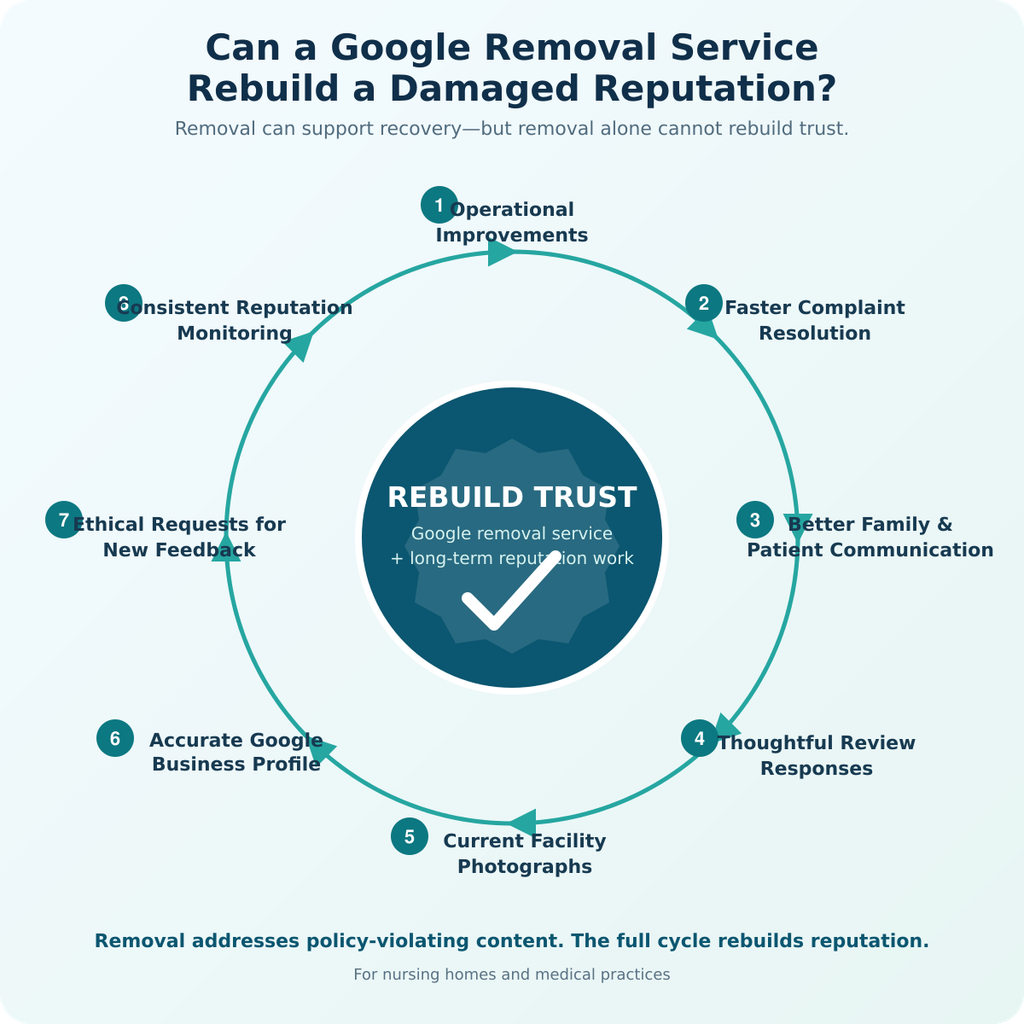
Work through six practical steps before reporting everything. The strongest recovery plan combines review analysis, operational improvement, professional responses and ethical review requests.
Stop and assess the pattern
Determine whether the reviews appeared naturally over time or arrived in a suspicious wave. Do not report every negative review automatically.
Investigate internally
Speak with administrators, department managers, compliance staff and employees. Repeated feedback may reveal an operational problem that removal cannot fix.
Report genuine policy violations
Report reviews only when there is a reasonable, policy-based argument. Damaging feedback is not automatically fake or removable.
Respond to reviews that remain
A calm public response can show future readers that your organization takes concerns seriously while protecting privacy.
Thank you for sharing your concerns. We take feedback seriously and would appreciate an opportunity to learn more. To protect everyone’s privacy, we cannot discuss individual circumstances publicly. Please contact our office directly and ask to speak with an administrator so we can review the matter appropriately.
Fix the cause
Reputation recovery becomes easier when the real-world experience improves. Convert the most common complaint into an owner, action and deadline.
Communication problem?
Create a callback standard, escalation contact and follow-up log.Families cannot reach staff?
Publish clear contacts and establish a documented escalation path.Repeated service complaint?
Assign ownership, measure the fix and check whether the complaint declines.Request new reviews ethically
Ask for honest feedback without rewards, pressure or requests for a particular rating.
Your recovery plan
- Complete the six steps to build your action summary.
Google Removal Service vs. Reputation Management
A Google removal service and reputation management are related, but they are not identical.
A Google removal service focuses primarily on reviews that may qualify for reporting and removal.
Reputation management is broader. It may include:
- Review monitoring
- Professional responses
- Ethical review requests
- Google Business Profile optimization
- Complaint analysis
- Service recovery
- Staff training
- Competitor comparisons
- Monthly reporting
- Reputation improvement planning
A healthcare organization with a serious reputation problem usually needs both.
The Google removal service addresses potentially prohibited content. The reputation strategy addresses what patients, residents, and families see after that content is reviewed.
Does Review Removal Improve Local SEO?
A Google removal service may help protect the quality and credibility of a review profile, but no ethical provider should guarantee higher local rankings from removing reviews.
Google local visibility depends on multiple factors. Review signals, profile relevance, location, prominence, website quality, business information, and user behavior may all contribute to performance.

A healthier reputation may encourage more people to:
- Click the listing
- Visit the website
- Request directions
- Call the organization
- Schedule an appointment
- Tour a nursing home
- Continue researching the provider
Therefore, the most realistic goal of a Google removal service is to protect trust and remove qualifying content—not promise an instant ranking increase.
Warning Signs of an Untrustworthy Google Removal Service
Be cautious if a company claims that it can remove every negative review.
Warning signs include:
- Guaranteed removal of all negative reviews
- Promises of overnight deletion
- No discussion of Google’s policies
- Attempts to access accounts unnecessarily
- Threats directed at reviewers
- Offers to purchase positive reviews
- Fake legal claims
- Requests to impersonate customers
- No explanation of what happens if Google rejects the report
- Large fees without a clear process
An ethical Google removal service should explain that Google makes the final decision.
It should also provide a recovery strategy for reviews that cannot be removed.
What to Look for in a Healthcare Google Removal Service
| What to Look For | Why It Matters |
|---|---|
| Policy-based review evaluations | Determines whether a review may actually violate Google’s policies |
| Transparent expectations | Helps you understand what can and cannot realistically be removed |
| Careful evidence collection | Strengthens legitimate reports involving suspicious or harmful reviews |
| Privacy-conscious responses | Protects patient and resident privacy when addressing complaints |
| No guaranteed removals | Shows the provider is honest because Google makes the final decision |
| No fake review generation | Protects your organization from policy violations and reputation damage |
| Clear reporting procedures | Ensures reviews are reported under the most relevant policy category |
| Monitoring and status updates | Keeps you informed about reports, decisions, and eligible appeals |
| Reputation recovery guidance | Helps rebuild trust when negative reviews cannot be removed |
| Healthcare experience | Ensures the provider understands medical practices, nursing homes, and privacy concerns |
The Bottom Line
The best Google removal service will tell you when a review probably does not qualify for removal. Honest, policy-based guidance is more valuable than an unrealistic promise.
Common Review-Removal Mistakes
Nursing homes and medical practices can make a reputation crisis worse by:
- Responding emotionally
- Accusing reviewers publicly
- Revealing private information
- Reporting every negative review
- Copying the same response under every complaint
- Threatening legal action without proper advice
- Purchasing positive reviews
- Asking employees to manipulate ratings
- Ignoring legitimate patterns
- Expecting a Google removal service to solve operational failures
The safest approach is calm, documented, policy-based, and focused on long-term trust.

A Better Reputation Recovery Strategy
The strongest strategy uses a Google removal service as one part of a larger plan.
A complete healthcare reputation recovery system should include:
- Daily or weekly review monitoring
- Fast internal escalation
- Policy-violation screening
- Professional response templates
- Compliance review when necessary
- Complaint tracking by category
- Monthly reputation reporting
- Ethical review-request procedures
- Staff accountability
- Service improvements based on recurring feedback
This approach helps an organization respond to immediate review problems while building a more resilient reputation.
Request a Free Healthcare Reputation Audit
Is your nursing home or medical practice struggling with fake reviews, suspicious ratings, damaging complaints, or a declining online reputation?
Our Google removal service can help evaluate your review profile and identify the best next step.
Your free reputation audit can include:
- Review-profile analysis
- Identification of possible policy violations
- Response-gap analysis
- Reputation risk assessment
- Google Business Profile review
- Competitor comparison
- Local visibility observations
- Recommended recovery priorities
Frequently Asked Questions
What is a Google removal service?
A Google removal service helps an organization identify, document, report, and monitor Google reviews that may violate Google’s content policies.
Can a Google removal service delete every negative review?
No. A Google removal service cannot guarantee deletion. Google decides whether a review violates its policies and qualifies for removal.
Can an honest negative review be removed?
Usually, a review cannot be removed merely because it is negative. If it describes a genuine experience and complies with Google’s policies, it may remain online.
What reviews may qualify for removal?
Potential examples include spam, fake engagement, impersonation, prohibited conflicts of interest, harassment, certain personal information, and other content that violates Google’s policies.
How can a Google removal service help a nursing home?
A Google removal service can examine suspicious reviews, document patterns, report potential violations, track decisions, and recommend responses for reviews that remain online.
How can a Google removal service help a medical practice?
A Google removal service can help a medical practice analyze questionable reviews while developing privacy-conscious responses and a larger reputation recovery strategy.
How long does Google review removal take?
Timing varies. Google states that evaluation typically takes several days, but complicated reports or appeals may take longer.
What happens if Google rejects the removal request?
The organization may have an opportunity to submit a one-time appeal for an eligible review. If the review remains, it should consider a professional response, internal investigation, and reputation improvement plan.
Should a nursing home respond to a negative review?
Generally, a calm and privacy-conscious response can demonstrate professionalism. The response should not confirm private details about a resident, patient, family member, or incident.
Can removal improve a healthcare organization’s reputation?
Removing qualifying fake or harmful content can support reputation protection. Long-term recovery, however, also requires better service, professional responses, ethical review requests, and consistent monitoring.
Protect Your Healthcare Reputation Today
Families and patients may judge your organization before they ever speak with your staff.
A professional Google removal service can help your nursing home or medical practice identify reviews that may violate Google’s rules, submit appropriate reports, monitor decisions, and respond strategically when content remains online.
The goal is not to erase honest criticism.
The goal is to protect your reputation from prohibited content, address legitimate concerns, improve the patient or resident experience, and rebuild trust over time.
Our Google removal service combines review analysis with practical reputation recovery recommendations for nursing homes and medical practices.
Claim Your Free Reputation Audit
We’ll help identify:
- Possible policy-violating reviews
- Suspicious review patterns
- Unanswered negative feedback
- Reputation weaknesses
- Response opportunities
- Google Business Profile concerns
- Long-term reputation priorities
- Google Review Removal Service That Protects Your Reputation and Builds Trust
- Google Review Management Agency That Helps Businesses Build Trust and Get More Customers
- How to Get New Patients in New York With Google Reviews
- How Accepted Insurance Plans Can Strengthen Medical Local SEO
- Brooklyn Nursing Home Marketing in 2026: How to Turn Google Searches Into More Admissions