
Reputation management healthcare providers rely on isn’t just a marketing tool—it’s a patient safety net. In medicine, trust isn’t just earned in the exam room anymore—it’s Googled.
I work with professionals across many fields, but none face higher standards of public trust than doctors and healthcare providers. In this space, a single negative review, one ignored patient complaint, or an outdated search result can quickly damage your credibility—and cost you patients.
That’s why online reputation management for healthcare providers has become essential. It’s not about ego—it’s about patient outcomes, safety, referrals, and even legal protection. And if you think you can afford to ignore it, you’re already at risk of falling behind.
The Reality: Your Next Patient Found You Online—and Judged You Before Calling
Let’s talk facts:
- 81% of patients read reviews before choosing a new doctor (Software Advice)
- 60% won’t consider providers with less than 4 stars—even if referred by another physician (Healthgrades)
- 1 in 3 patients say a doctor’s online presence influences their decision more than credentials (PatientPop)
This is the new landscape of reputation healthcare and online reputation management for doctors. Patients form opinions before you ever speak with them.
If you’re not actively managing your online reputation, your practice is at risk. Outdated listings, unanswered reviews, and poor ratings can create a perception that drives potential patients away.
Reputation management for doctors is about more than review control. It’s about building trust, improving local SEO, and presenting a clear, credible image across all digital platforms.
In today’s digital-first world, your online presence matters as much as your clinical expertise. Take control before someone else defines your brand.
What Online Reputation Management for Doctors Really Means
It’s more than responding to reviews. It includes:
- Monitoring every platform patients use to research providers
- Proactively collecting reviews from satisfied patients
- Responding professionally to negative feedback
- Optimizing your Google presence and doctor directory profiles
- Creating a consistent digital narrative that reflects your values and expertise
I’ve helped physicians recover from damaging reviews, false accusations, and old malpractice references—all with targeted online reputation management for doctors strategies.
Real Story: The Pediatrician Nearly Crushed by One Yelp Review
A pediatrician I worked with had a near-perfect reputation for over a decade. Then a frustrated parent wrote a 1-star review after a billing issue. The review claimed the doctor “didn’t care about children,” even though the situation was administrative.
That one review:
- Dropped their average rating from 4.9 to 4.2
- Got shared in a local moms’ group on Facebook
- Led to a 20% drop in new patient calls over the next two months
We stepped in with a custom online reputation management for doctors plan:
✅ Flagged the review for removal (violated policy)
✅ Collected 30+ fresh reviews from happy patients
✅ Updated all practice listings
✅ Posted a patient-centered values statement on the homepage
✅ Set up automated feedback collection via text
The rating jumped to 4.8, the Facebook thread was buried, and the calls came back.

Why Doctors Can’t Treat Reputation Like Other Businesses
Here’s what makes online reputation management for doctors so uniquely critical:
- HIPAA limits how you can respond to patient complaints publicly—even if the review is misleading or unfair
- Patients expect empathy, not just outcomes—they judge your bedside manner just as much as your medical skills
- Health is emotional, so negative reviews often reflect frustration or fear, even when the care was clinically sound
- Medical boards, insurers, and potential employers monitor your online reputation—not just patients
- One wrong response can escalate fast, leading to legal exposure or career consequences
This isn’t a restaurant or retail review problem. Your digital presence is directly tied to your license, livelihood, and long-term trust with your community.
That’s why doctors need a tailored, compliant approach to reputation management—not a one-size-fits-all strategy pulled from Yelp playbooks. When it comes to your online image, protecting it is part of protecting your practice.
Core Elements of a Doctor-Focused Reputation Strategy
Reputation management for doctors isn’t just about cleaning up bad reviews—it’s about protecting your name, your practice, and your future. In a profession where online presence directly influences trust, referrals, and even hiring decisions, your digital reputation can’t be left to chance.
When I build a reputation strategy tailored for healthcare professionals, these are the non-negotiables:
1. Audit Every Listing and Search Result
Before we can improve your reputation, we need to know what the internet is saying about you. This means auditing every profile and listing tied to your name and practice.
Key platforms to review include:
- Google Business Profile
- Healthgrades
- Vitals
- WebMD
- Zocdoc
- RateMDs
- RealSelf (for cosmetic and aesthetic specialties)
We look for inconsistent contact information, duplicate listings, missing or outdated bios, and low-quality images. These errors hurt your local SEO and can confuse or deter patients.
According to BrightLocal, 88% of consumers say they trust online reviews and listings as much as a personal recommendation when details are consistent. That means even a small error—like a mismatched phone number—can reduce trust and damage your credibility.
A comprehensive audit is the first step in reclaiming control of your digital presence.
2. Build a Patient Review Funnel
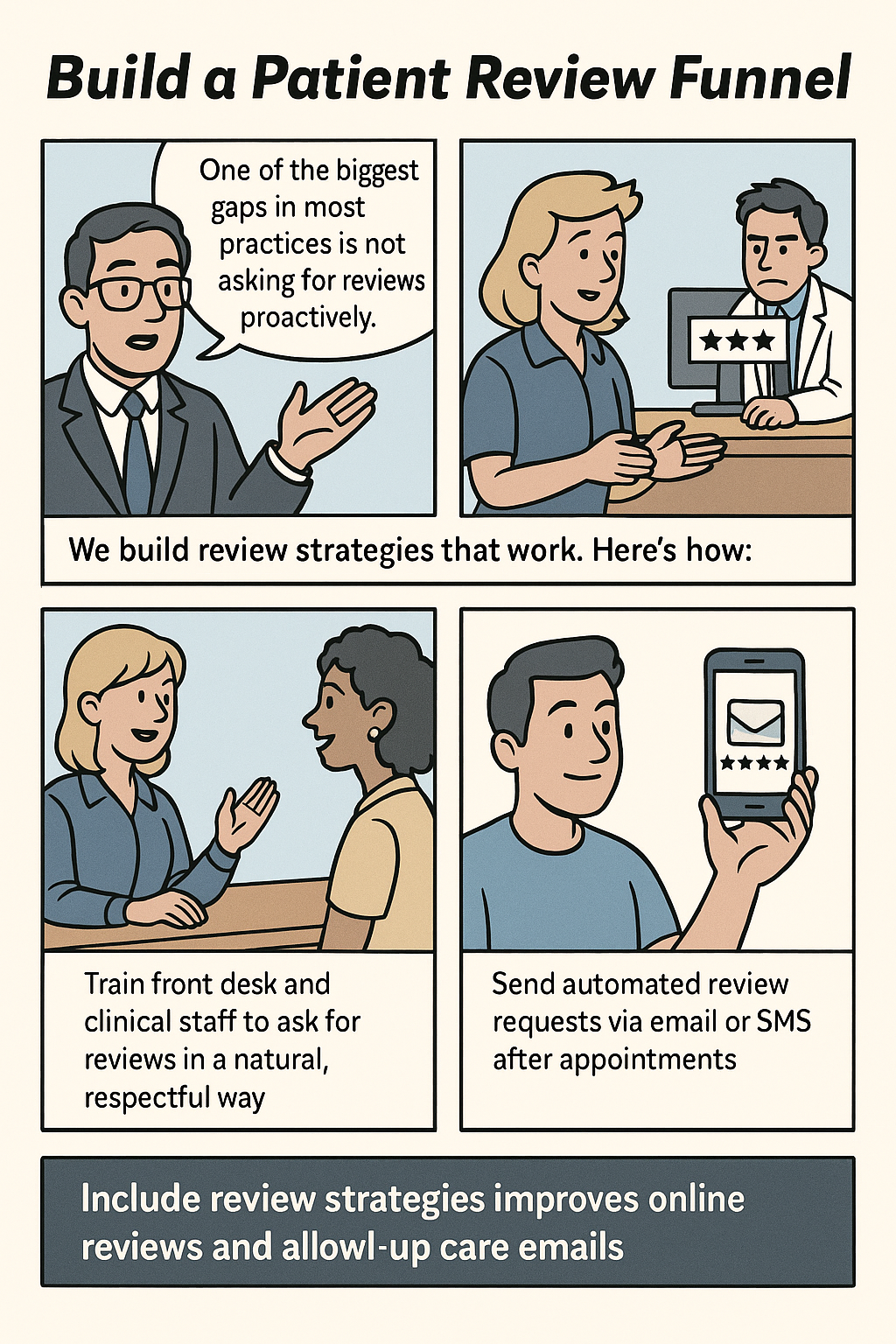
One of the biggest gaps in most practices is not asking for reviews proactively. If you’re only collecting feedback after something goes wrong, you’re handing your reputation to your most frustrated patients.
We build review strategies that work. Here’s how:
- Train front desk and clinical staff to ask for reviews in a natural, respectful way
- Send automated review requests via email or SMS after appointments
- Include review prompts in post-visit instructions and follow-up care emails
This approach consistently improves online reviews. In fact, practices we’ve worked with have seen review volume grow 4x in 90 days just by making it part of the workflow.
And it matters. According to a Software Advice survey, 94% of patients use online reviews to evaluate doctors—and 43% would consider switching providers based on poor ratings.
A strong review strategy builds trust, supports your reputation management, and improves visibility in search results.
3. Respond Professionally (Without Breaking HIPAA)
Many physicians fear responding to reviews due to HIPAA restrictions—and rightfully so. But silence can look like indifference. That’s why it’s critical to have a process in place to respond to reviews carefully and compliantly.
We craft pre-approved templates that express empathy, reinforce your professionalism, and encourage offline follow-up—without revealing protected health information.
Example:
“We strive to provide the best care for every patient. While we can’t comment on specific situations publicly, we take all concerns seriously and invite you to contact our office directly.”
This type of response supports online reputation management, shows leadership, and keeps you legally protected.
Remember, patients aren’t just reading the reviews—they’re reading how you respond. According to ReviewTrackers, 53% of consumers expect a business to respond to a negative review within a week—but many doctors don’t respond at all. That’s a missed opportunity to show accountability and care.
4. Publish Trust-Building Content
When patients research doctors, they’re not just looking for credentials—they’re looking for reassurance. The best way to provide that? Content that builds trust.
We help doctors publish content that supports both SEO and reputation management efforts:
- FAQ pages that answer common patient concerns
- Welcome videos that humanize the provider
- Care team spotlights to showcase your staff
- Health-focused blog posts on trending or seasonal topics
- Patient testimonials (with written consent)
This content helps dominate Google search results, pushing down negative reviews and creating a stronger online presence. It also helps with digital marketing—driving traffic, supporting email campaigns, and improving patient conversion.
And it works. Practices with consistent, educational blog content generate 55% more website visitors, according to HubSpot.
It’s not just about damage control—it’s about building a digital reputation that patients trust before they ever step into your office.
Common Mistakes That Damage Online Reputations
Here’s what I see too often—and fix fast:
❌ Ignoring reviews altogether
❌ Letting front desk staff respond emotionally
❌ Using reputation services that aren’t HIPAA-aware
❌ Not addressing legitimate patient concerns
❌ Failing to train the team on brand language
All of these make online reputation management for doctors harder—and more expensive—than it needs to be.

Key Stats Every Healthcare Provider Should Know
- Responding to reviews increases patient trust by 44% (Software Advice)
- 1 in 4 patients have switched providers due to poor online reviews (PatientPop)
- Practices with 50+ reviews grow 2x faster than those with less than 10 (Healthgrades)
If you think reputation is secondary, these numbers say otherwise.
Final Word: Reputation Is a Medical Asset
Think of your online reputation like your stethoscope—you wouldn’t walk into a room without it. So don’t leave your digital presence unprotected.
Online reputation management for doctors is more than damage control—it’s a way to demonstrate your care, your commitment, and your credibility 24/7.
In a world where trust is built on search results, your next patient is only a click away from choosing someone else. Let’s make sure your story is the one they see.
Want Help Managing Your Online Presence?
I help healthcare providers:
- Audit and improve online reputation across all platforms
- Set up HIPAA-safe review response systems
- Train staff on brand-safe communication
- Build SEO-driven content to dominate Page 1 of Google
Let’s make your digital reputation as trustworthy as your care.