Imagine a Family Searching for a Nursing Home in New York City
A family is sitting around a kitchen table trying to make one of the most emotional decisions of their lives.
Their loved one can no longer live safely at home. The family needs a nursing home in Brooklyn, Queens, Manhattan, the Bronx, or Staten Island—and they need to feel confident about the choice.
They open Google and begin comparing facilities.
One nursing home has recent reviews, thoughtful public responses, updated photographs, and clear contact information.
Another has unanswered complaints, old reviews, an incomplete Google Business Profile, and no visible sign that management is paying attention.
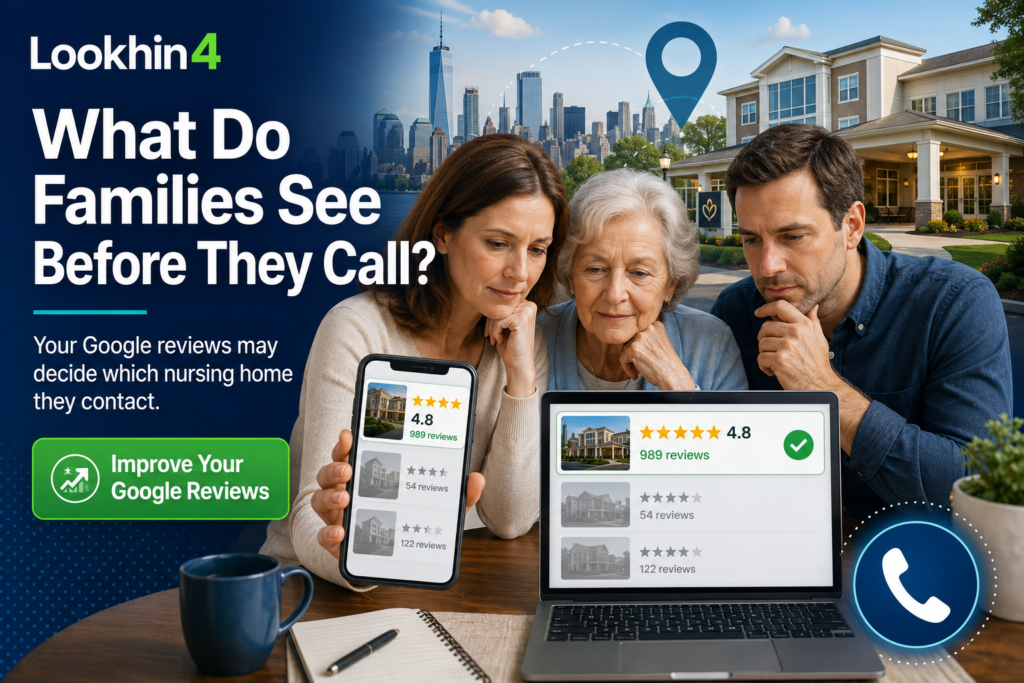
Which facility feels more trustworthy?
Families understand that no nursing home is perfect. However, they want to see evidence that administrators listen, communicate, and take concerns seriously.
That is why Google review monitoring for nursing homes is no longer a task that should be checked only when someone remembers.
A professional monitoring system helps NYC nursing-home administrators:
Show leadership how the facility’s reputation is changing
Receive alerts when new reviews appear
Identify serious concerns quickly
Respond through an approved process
Protect resident and family privacy
Track recurring themes
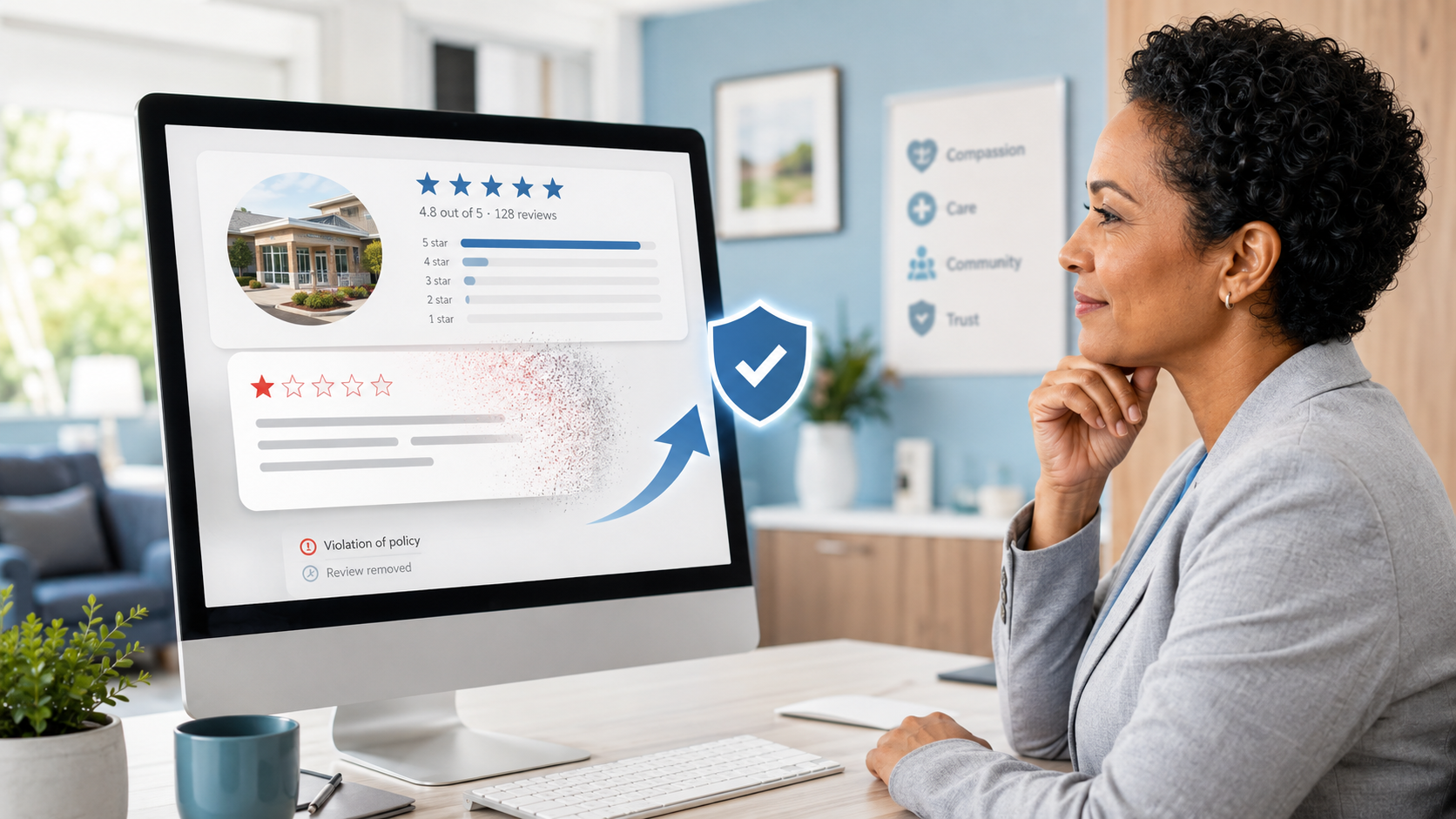
Flag reviews that may violate Google’s policies
Strengthen public trust
Support the facility’s Google Business Profile and Local SEO
The Reputation Problem Many Nursing-Home Administrators Do Not See in Time
Nursing-home administrators already manage staffing, compliance, resident care, family communication, admissions, operations, vendors, inspections, and emergencies.
Checking Google may fall to the bottom of the list.
Unfortunately, families do not wait for the facility to catch up.
While management is focused on daily operations, the public may be reading reviews about:
How concerns were handled
Staff communication
Resident care
Cleanliness
Food
Activities
Call-bell response
Admissions
Billing
Visitation
Personal belongings
Discharge planning
Without active monitoring, a facility may miss:
- A serious complaint that requires internal escalation
- An inaccurate statement spreading publicly
- A possible fake or policy-violating review
- A positive review that deserves acknowledgment
- Repeated complaints pointing to an operational problem
- Questions from prospective families
- A gradual decline in its overall rating
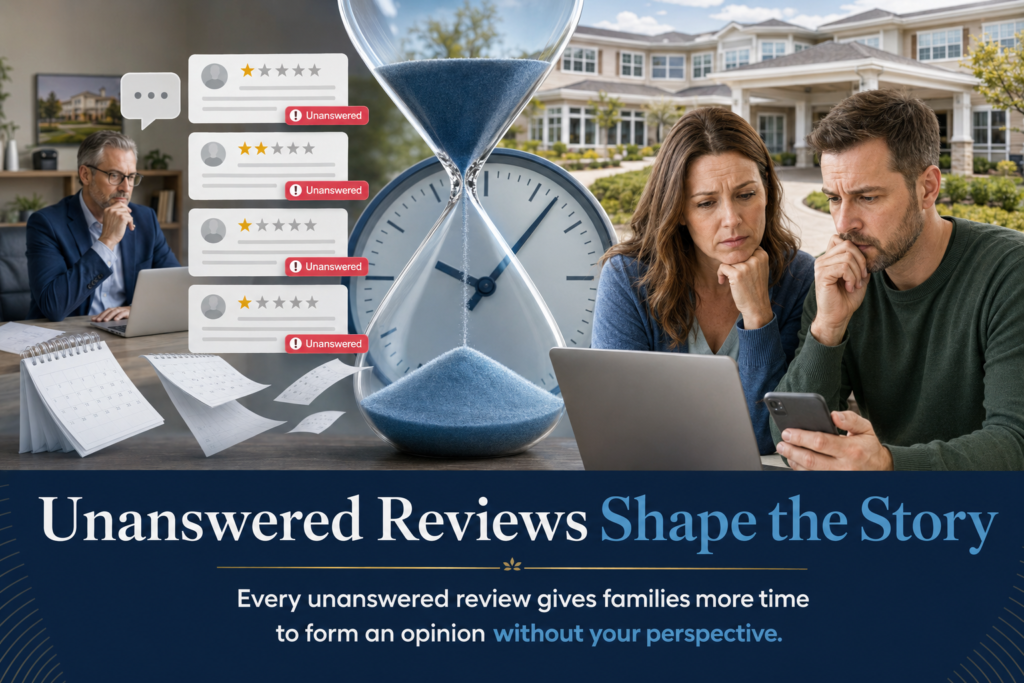
The longer reviews sit unanswered, the more time prospective families have to form an opinion without hearing the facility’s professional perspective.
What Is Google Review Monitoring for Nursing Homes?
Google review monitoring for nursing homes is a structured process for tracking, evaluating, escalating, and responding to public feedback posted on a facility’s Google Business Profile.
A monitoring service may include:
- New-review alerts
- Rating-change alerts
- Negative-review escalation
- Review-response support
- Privacy-conscious response templates
- Trend and sentiment tracking
- Possible fake-review identification
- Google policy reporting guidance
- Google Business Profile monitoring
- Competitor review comparisons
- Monthly reputation reporting
- Local SEO recommendations
Monitoring is not simply watching the star rating.
It gives administrators a process for deciding:
Is the feedback part of a larger operational pattern?
What happened publicly?
Does the review require internal investigation?
Who should be notified?
What can the facility safely say in public?
Should the conversation move to a private channel?
Does the review appear to violate Google’s policies?
Why Google Reviews Matter to NYC Nursing Homes
Families may compare multiple facilities before requesting information or scheduling a tour.
Google reviews can shape their first impression before they speak with admissions.
Prospective families may examine:
Directions, hours, phone numbers, and website links
Overall star rating
Total number of reviews
How recent the reviews are
Specific comments about staff and care
The tone of management’s responses
Whether complaints are ignored
Photographs and facility information
Google reviews should not be treated as the only source of information about nursing-home quality. Families may also review government resources, inspection information, referrals, tours, clinical needs, insurance coverage, location, and personal recommendations.
But Google is often one of the first and easiest places families look.
That makes your facility’s public review profile part of the admissions journey.
The Family Decision Journey
Google search → Facility profile → Reviews and responses → Website → Phone inquiry → Tour → Admissions conversation
If trust breaks at the review stage, the family may never reach your admissions team.
How Unanswered Reviews Can Affect Family Trust
An unanswered review does not automatically mean a facility is careless. Administrators may be investigating privately or following internal procedures.
Prospective families cannot see that work.
They only see the public silence.
When multiple reviews remain unanswered, a reader may wonder:
- Is management listening?
- Will someone return my calls?
- How are family concerns handled?
- Is the facility active online?
- Does leadership take accountability seriously?
A brief, professional, privacy-conscious response cannot resolve every issue. It can, however, show that the facility has a process and invites appropriate private communication.
The Administrator’s Review-Monitoring Workflow
Every nursing home should establish a clear review management process before a challenging review appears. Assigning responsibilities in advance helps ensure timely, professional, and compliant responses while protecting your facility’s reputation.
| Review Management Step | Recommended Responsibility | Purpose |
|---|---|---|
| 📩 Receive Review Alert | Administrator, designated manager, or reputation partner | Ensure new reviews are identified immediately so they can be evaluated without delay. |
| 📋 Preserve & Document the Review | Designated internal contact | Record the review and supporting details for quality assurance and future reference. |
| ⚠️ Screen for Urgency | Administrator or authorized leader | Determine whether the review requires immediate attention due to safety, regulatory, or reputational concerns. |
| 🔍 Investigate Operational Issues | Appropriate department head | Review the facts and determine whether staffing, communication, care, or operational improvements are needed. |
| 🔒 Review Privacy & Compliance Risks | Privacy officer, compliance lead, or legal counsel | Verify that any public response complies with HIPAA and organizational policies. |
| ✍️ Draft the Public Response | Authorized responder or reputation management partner | Prepare a professional, empathetic, and policy-compliant response that reflects the facility’s values. |
| ✅ Approve Sensitive Responses | Administrator and compliance leadership | Review responses involving serious complaints before they are published. |
| 📞 Contact the Reviewer Privately (When Appropriate) | Authorized staff member | Attempt to resolve concerns directly while maintaining resident privacy and professionalism. |
| 📈 Track Recurring Themes | Administrator and Quality Improvement team | Identify trends involving communication, staffing, wait times, cleanliness, meals, or resident care. |
| 📊 Report Monthly Trends | Administrator, ownership, or executive leadership | Review performance metrics, identify improvement opportunities, and measure progress over time. |
Best Practice: A documented review-monitoring workflow prevents rushed, emotional, or unauthorized public responses while promoting consistent communication, regulatory compliance, and continuous quality improvement.
Real-Time Review Alerts

Administrators should know when a new review is posted—not weeks later during an occasional profile check.
Alerts may notify the designated team when:
- A new review appears
- A low rating is posted
- The overall rating changes
- A review contains a serious allegation
- Several reviews mention the same problem
- A public response is still pending
- A suspicious burst of reviews occurs
Speed does not mean responding without investigation.
It means starting the correct process quickly.
Some reviews can be acknowledged promptly. Others require internal review before anything is published.
Negative Review Monitoring and Internal Escalation
A one-star review can involve anything from dissatisfaction with parking to a serious allegation about care.
The public response should not be the administrator’s first and only action.
The review may need to be routed internally based on its content.
Possible escalation categories
- Resident safety
- Quality of care
- Staff conduct
- Abuse or neglect allegations
- Medication concerns
- Infection-control concerns
- Missing belongings
- Billing or insurance disputes
- Admissions communication
- Discharge planning
- Food or dietary concerns
- Cleanliness and maintenance
- Visitation
- Staffing complaints
A reputation-management system does not replace clinical, legal, compliance, quality-assurance, grievance, reporting, or regulatory procedures.
Its purpose is to ensure that public feedback reaches the right people and does not disappear in an unmanaged inbox.
HIPAA-Conscious Responses Are Essential
Healthcare providers must be extremely careful when responding to online reviews.
A reviewer may publicly identify a resident, describe care, or disclose private details. That does not automatically authorize the facility to confirm the person’s residency, treatment, condition, dates, family relationship, or other protected information.
The U.S. Department of Health and Human Services has taken enforcement action against healthcare providers for disclosing protected information while responding to negative online reviews. Review the HHS enforcement example involving online-review responses.
Nursing-home administrators should establish a response policy that includes:
- Never confirming that someone is or was a resident
- Never identifying a resident through a family member’s review
- Never discussing care, medication, diagnoses, billing, dates, or incidents publicly
- Never correcting a reviewer by revealing private facts
- Moving detailed conversations to an approved private channel
- Limiting profile access to authorized staff
- Requiring approval for sensitive responses
- Escalating high-risk reviews to compliance or legal leadership
- Training everyone who may draft or publish replies
Example of a Privacy-Conscious Public Response
Thank you for sharing your concerns. Our facility takes feedback seriously and is committed to providing a safe, respectful experience for everyone we serve. Please contact our administrator directly at [phone number] so the appropriate team member can discuss your concerns privately.
This is a general example—not legal advice. Your facility should use language approved under its own privacy, compliance, and legal procedures.
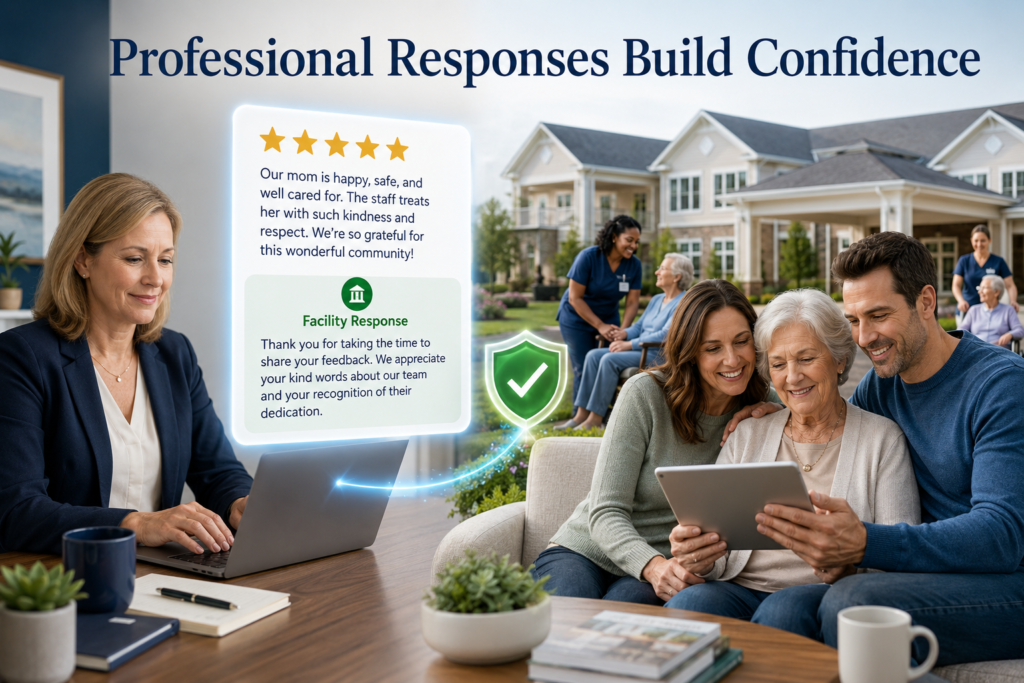
Professional Responses Build Confidence
Families often read the facility’s replies as closely as the original reviews.
A professional response can demonstrate:
Commitment to improvement
Respect
Attentiveness
Accountability
Calm leadership
Willingness to communicate
Positive reviews
Thank the reviewer without confirming protected details.
Example:
Thank you for taking the time to share your feedback. We appreciate your kind words about our team and your recognition of their dedication.
General negative reviews
Acknowledge the concern, avoid an argument, and invite private contact.
Example:
Thank you for bringing this concern to our attention. We take feedback seriously and would welcome the opportunity to discuss it through the appropriate private channel. Please contact our administrator at [phone number].
Reviews containing inaccurate claims
Do not reveal private information while trying to prove the reviewer wrong.
Example:
We take all feedback seriously. To protect privacy, we cannot address individual circumstances in a public forum. Please contact our administrator directly so the appropriate team can review your concerns.
Fake, Spam, and Policy-Violating Reviews
Not every unwanted review qualifies for removal.
Google does not remove reviews simply because a business disagrees with them or considers them unfair.
Reviews may be reportable when they violate Google’s policies—for example, content involving fake engagement, spam, harassment, conflicts of interest, or other prohibited material.
Administrators should:
- Preserve a screenshot and link.
- Document why the review may violate a specific policy.
- Flag the review through the Google Business Profile.
- Track the report.
- Use Google’s review-management process for eligible appeals.
- Avoid encouraging staff, vendors, or personal contacts to attack the reviewer.
See Google’s prohibited and restricted content policy and instructions for reporting inappropriate reviews.
Review Monitoring Can Reveal Operational Patterns
Every Google review tells part of a story, but a single review should never be viewed as the complete picture of resident or family satisfaction. The greatest value comes from identifying recurring themes that can help nursing home administrators improve operations, strengthen communication, and enhance the resident experience.
| Recurring Review Theme | Question for Administrators | Potential Improvement Opportunity |
|---|---|---|
| 📞 Calls Are Not Returned | Is there a designated owner for family calls and a defined response-time standard? | Improve call-routing procedures, accountability, and response times. |
| 💬 Staff Communication Varies | Are all shifts following the same communication standards and receiving consistent training? | Standardize expectations through training and documented procedures. |
| 👨👩👧 Families Feel Uninformed | Are care updates, points of contact, and escalation procedures clearly communicated? | Increase proactive communication with residents’ families. |
| 🧹 Cleanliness Concerns | Are inspections, housekeeping assignments, and corrective actions documented and reviewed? | Strengthen quality assurance and environmental services oversight. |
| 🍽️ Food Complaints | Are dietary concerns being documented, routed, and resolved consistently? | Improve communication between dietary staff, nursing, and residents. |
| 🎒 Missing Belongings | Is the personal property process clearly explained and consistently followed? | Review inventory procedures and educate residents and families on reporting processes. |
| 🌟 Positive Staff Recognition | Are outstanding employees being acknowledged and rewarded? | Reinforce excellent service and boost staff morale through recognition programs. |
| 📝 Admission Confusion | Are new residents and families receiving consistent information before admission? | Standardize admission packets, orientation materials, and onboarding procedures. |
Why This Matters
Monitoring Google reviews isn’t just about protecting your online reputation—it can become a valuable source of operational insight. When multiple families mention the same issue, administrators gain actionable information that can support:
- Staff training and coaching
- Quality improvement initiatives
- Leadership and department meetings
- Service recovery efforts
- Resident and family satisfaction
- Continuous operational improvement
By identifying patterns instead of reacting to isolated comments, nursing homes can make informed decisions that improve both resident care and their online reputation.
Google Reviews, Tours, Admissions, and Occupancy
Google reviews do not guarantee admissions or occupancy.
However, a nursing home’s online reputation can influence whether a family:
Keeps the facility on the final shortlist
Clicks the facility profile
Visits the website
Calls admissions
Requests information
Schedules a tour
The relationship can be understood as:
Stronger public trust → More qualified inquiries → More tour opportunities → More admissions conversations → Greater opportunity to support occupancy
Clinical suitability, bed availability, payer requirements, referrals, location, government information, and the in-person experience still matter.
Review monitoring supports the trust stage of that process.
Google Reviews and Local SEO for Nursing Homes
Reviews are one part of a broader Local SEO strategy.
A strong reputation profile may help a nursing home:
Strengthen the overall conversion experience
Build trust in Google Search and Maps
Encourage more people to click or call
Present current public feedback
Demonstrate active profile management
Review monitoring should work alongside:
- Accurate facility name, address, and phone number
- Correct Google Business Profile categories
- Updated hours and contact information
- Quality facility photographs
- Service and amenity information
- A mobile-friendly website
- Borough and neighborhood relevance
- Consistent local listings
- Nursing-home and long-term-care content
- Ethical review requests
No responsible provider should guarantee that reviews alone will place a facility at the top of Google Maps.
Google Business Profile Monitoring
Your Google Business Profile is often the first impression families have of your nursing home. Regular monitoring helps ensure prospective residents and their loved ones always see accurate, up-to-date information when searching on Google Search and Google Maps.
| Google Business Profile Item | Why It Should Be Monitored | Potential Impact if Incorrect |
|---|---|---|
| 🏥 Facility Name | Verify the official business name is accurate and consistent. | Confuses families and weakens brand recognition. |
| 📍 Address & Map Location | Ensure Google Maps directs visitors to the correct entrance and location. | Missed tours, frustrated families, and lost admissions. |
| ☎️ Main Phone Number | Confirm calls reach the admissions or main office without issue. | Prospective residents may contact the wrong number—or a competitor instead. |
| 🌐 Website Link | Make sure visitors are directed to the correct website or admissions page. | Lost inquiries, broken links, and reduced trust. |
| 🕒 Business Hours & Holiday Hours | Keep operating hours current throughout the year. | Families may arrive when the office is closed or staff are unavailable. |
| 🩺 Business Categories | Verify primary and secondary categories accurately describe your facility. | Reduced visibility for relevant Google searches. |
| 📋 Services & Amenities | Keep services, specialties, and amenities updated. | Families may overlook services your facility actually provides. |
| 📸 Photos & Videos | Regularly add professional images of your facility, staff, and common areas. | Outdated or limited visuals can reduce confidence before a tour. |
| ⭐ Review Activity | Monitor new reviews and identify recurring feedback trends. | Missed opportunities to thank families or address concerns promptly. |
| 💬 Public Responses | Respond professionally and consistently to patient and family feedback. | Unanswered reviews may create the impression that feedback is ignored. |
| ✏️ Suggested Edits | Review Google user-submitted edits before they become public. | Incorrect information may appear without your knowledge. |
| 🔄 Duplicate Business Profiles | Identify and remove duplicate Google Business Profiles. | Reviews become split across listings, reducing visibility and causing confusion. |
Administrator Tip: Google Business Profile monitoring isn’t only about responding to reviews. Keeping your profile accurate, complete, and actively maintained helps create a positive first impression before a family ever calls, schedules a tour, or visits your facility. A well-managed profile supports stronger Local SEO, improves trust, and increases the likelihood that families choose your nursing home over competing facilities.
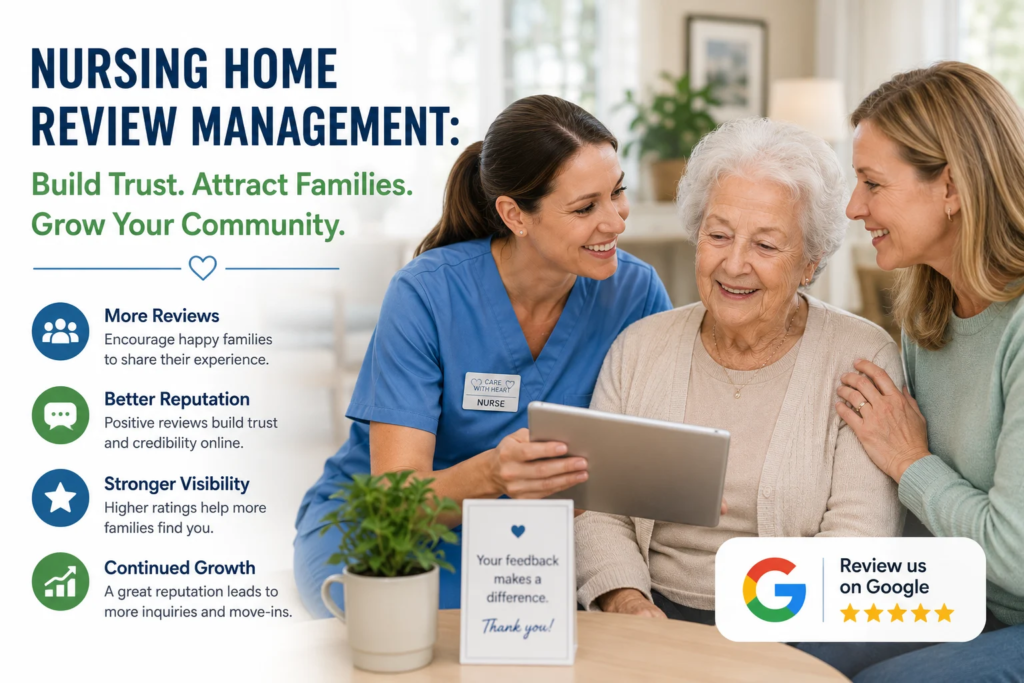
How to Request More Authentic Nursing-Home Reviews
Monitoring protects the reputation you have. A consistent, ethical request process helps build the reputation you want.
Google allows businesses to share a review-request link or QR code. See Google’s review-link guidance.
Depending on facility policies and applicable requirements, review opportunities might occur after:
Another appropriate experience
A family expresses appreciation
A positive care meeting
A successful transition or discharge
A family event
A compliment about staff
A resolved concern
Requests should seek honest feedback—not demand five stars.
Avoid:
- Buying reviews
- Writing reviews for families
- Offering rewards for positive ratings
- Asking employees to pose as family members
- Pressuring residents or families
- Using misleading review tactics
- Sending public-review requests only after privately screening for positive sentiment
Authentic reviews build sustainable trust.
| Statistic | What the Research Found | Why It Matters for Nursing Homes |
|---|---|---|
| 2.5% more total admissions | A one-star increase in a nursing home’s Yelp rating was associated with a 2.5% increase in total resident admissions. | Better public ratings can directly increase consumer demand and admissions. INFORMS study |
| 4.7% more Medicare admissions | A one-star increase in a nursing home’s Yelp rating was associated with a 4.7% increase in Medicare-covered admissions. | Strong reviews may be especially valuable for attracting short-term rehabilitation and Medicare residents. INFORMS study |
| More than 6% market-share gain | After Medicare introduced its nursing-home star-rating system, five-star facilities gained more than 6% in market share. | Higher ratings can help a nursing home capture admissions that might otherwise go to nearby competitors. Consumer Response to Nursing Home Ratings |
| 8% market-share loss | After the rating system was introduced, one-star nursing homes lost approximately 8% of their market share. | Poor ratings can cost facilities prospective residents before families schedule a tour. Consumer Response to Nursing Home Ratings |
| 3.6% more admissions | Nursing homes receiving three stars experienced a 3.6% increase in admissions compared with two-star facilities. | Even a moderate rating improvement may make a measurable difference in admissions. Consumer Response to Nursing Home Ratings |
| 85% influenced by positive reviews | 85% of consumers said positive reviews make them more likely to use a business. | Positive feedback can build the trust families need before contacting a nursing home. BrightLocal 2026 survey |
| 20% contact the business | After reading positive reviews, 20% of consumers contact the business. | Better reviews can generate more calls and admission inquiries. BrightLocal 2026 survey |
| 20% make an appointment | Positive reviews motivated 20% of consumers to make an appointment. | For nursing homes, this can translate into more consultations, facility tours, and admission assessments. BrightLocal 2026 survey |
| 80% favor businesses that respond | 80% of consumers said they would likely use a business that responds to all its reviews. | Professional responses demonstrate that nursing-home leadership listens to residents and families. BrightLocal 2026 survey |
| 42% avoid businesses that ignore reviews | 42% of consumers are unlikely to choose a business that never responds to reviews. | Ignoring reviews can make a facility appear inattentive or unconcerned about family feedback. BrightLocal 2026 survey |
Common Nursing-Home Review-Monitoring Mistakes
Checking Google only once a month
Important feedback may sit publicly for weeks without reaching leadership.
Responding emotionally
A defensive reply can make the facility appear less professional and may increase privacy risk.
Allowing too many staff members to respond
Unclear access and authority can lead to inconsistent or unauthorized statements.
Copying the same response everywhere
Templates help, but repetitive replies can appear robotic. Each response should be appropriately adapted without exposing private information.
Promising that every negative review will be removed
Google generally removes content for policy violations—not simply because it is negative.
Focusing only on the star rating
Review themes may reveal communication, staffing, operational, or service-recovery opportunities.
Treating public responses as complaint investigations
The public reply is not the place to debate facts or disclose details. Investigation belongs in the facility’s approved internal process.
Ignoring positive reviews
Positive feedback can strengthen morale and highlight staff members or practices worth recognizing.
Staff-Managed Monitoring vs. Lookhin4 Support
| Responsibility | Managed by Existing Staff | Lookhin4 Review Management |
|---|---|---|
| Monitor New Reviews | Staff manually checks the Google Business Profile throughout the day. | Automated monitoring with instant review alerts and notifications. |
| Identify Urgent Concerns | Depends on staff availability and whether someone notices the review. | Structured escalation process helps identify priority issues quickly. |
| Draft Public Responses | Staff writes responses from scratch, often with limited guidance. | Professional response drafting guidance that supports consistency and professionalism. |
| Maintain a Consistent Voice | Tone and messaging vary depending on who responds. | Defined response strategy that reflects your facility’s brand and values. |
| Track Response Gaps | Manual tracking or no formal process. | Organized monitoring to ensure reviews receive timely attention. |
| Analyze Recurring Feedback | Often postponed because of daily operational demands. | Trend reporting identifies recurring concerns such as communication, cleanliness, dining, or staffing. |
| Monitor Competitors | Requires significant time researching nearby nursing homes. | Competitive review assessments show how your reputation compares with local facilities. |
| Support Local SEO | Requires additional marketing knowledge and ongoing effort. | Review management integrated with Google Business Profile optimization and Local SEO strategy. |
| Generate Leadership Reports | Administrators manually compile spreadsheets and summaries. | Clear monthly reports highlighting review growth, ratings, response times, trends, and opportunities. |
| Save Administrative Time | Review monitoring becomes another responsibility added to an already busy schedule. | Reduces repetitive monitoring tasks so administrators can focus on resident care and operations. |
| Continuous Reputation Management | Process depends on staff remembering each step consistently. | A dependable system that continuously monitors, organizes, and supports your online reputation. |
The Goal Isn’t to Replace Your Administrator
Lookhin4 is designed to support—not replace—your nursing home administrator. By handling repetitive review monitoring, organizing reputation data, and providing actionable insights, administrators gain better visibility into resident and family feedback while spending more time focused on operations, quality improvement, and resident care.
What Makes Lookhin4’s Nursing-Home Review Monitoring Different?
Lookhin4 focuses on the needs of healthcare facilities and the administrators responsible for them.
Depending on the selected service, support may include:
- New-review monitoring
- Negative-review alerts
- Response drafting and guidance
- Privacy-conscious response workflows
- Reputation trend reports
- Competitor review comparisons
- Google Business Profile guidance
- Ethical review-request systems
- Local SEO recommendations
- Review-growth strategy
The goal is not simply to collect stars.
The goal is to help your nursing home become a more visible, trusted, and responsive choice for NYC families.

Request a Free NYC Nursing-Home Reputation Assessment
CTA: See Your Nursing Home Through a Family’s Eyes
Request a free Google Review and Local SEO assessment.
Primary Button: Get My Free Reputation Assessment
Secondary Button: Schedule a Nursing Home Consultation
If your facility is dealing with unanswered reviews, inconsistent monitoring, weak visibility, outdated feedback, or stronger-looking competitors, begin with an assessment.
We will review:
Ethical review-growth opportunities
Current rating and review count
Review recency
Response rate and response quality
Positive and negative themes
Nearby competitors
Google Business Profile completeness
Possible Local SEO gaps
Frequently Asked Questions
What is Google review monitoring for nursing homes?
It is a structured process for tracking new reviews, alerting administrators, escalating concerns, supporting appropriate responses, analyzing trends, and protecting the facility’s online reputation.
Why should a nursing-home administrator monitor Google reviews?
Families may read reviews before calling or touring. Monitoring helps administrators identify feedback quickly, respond through an approved process, recognize recurring concerns, and understand what prospective families see.
How fast should a nursing home respond to a review?
The facility should begin its review and escalation process promptly. The public response time depends on the review’s seriousness, required investigation, privacy considerations, and internal approval process. Accuracy and privacy matter more than rushing.
Can a nursing home respond to a family member’s negative review?
Yes, but the response must not disclose protected information or improperly confirm details about a resident or family relationship. Sensitive responses should follow the facility’s approved privacy and compliance process.
Can a negative review be removed?
Only reviews that violate Google’s policies may qualify for removal. A review is not automatically removable because it is negative, inaccurate, or unfair. The facility should document the potential policy violation and use Google’s reporting process.
Can Google reviews help a nursing home attract more families?
A strong, current review profile may increase trust and encourage calls or tours. Reviews are one influence among many, including clinical needs, location, referrals, government information, insurance, availability, and the family’s in-person experience.
Does review monitoring improve Local SEO?
Monitoring supports an active reputation strategy and helps the facility maintain its public presence. Reviews should be combined with Google Business Profile optimization, accurate listings, a strong website, relevant local content, and other Local SEO work.
Can Lookhin4 help our facility get more reviews?
Yes. Lookhin4 can help create an ethical review-request process designed to encourage authentic feedback from appropriate residents, families, and other eligible participants without buying reviews or promising specific ratings.
Is the service only for Brooklyn nursing homes?
No. Lookhin4 can support nursing homes and long-term-care facilities throughout Brooklyn, Queens, Manhattan, the Bronx, Staten Island, and other service areas.
Conclusion
Families searching for nursing-home care are not simply comparing buildings, services, or locations. They are searching for reassurance that their loved one will be safe, respected, and cared for.
Your Google reviews help shape that impression before a family ever calls your admissions office or schedules a tour.
Every unanswered complaint, outdated review, or missed compliment leaves part of your facility’s story in someone else’s hands. Consistent review monitoring allows your administration to respond professionally, identify recurring concerns, recognize excellent staff, and show families that leadership is listening.
Your team works hard every day to care for residents. Your online reputation should reflect that commitment.
Find out what families see when they search for your nursing home—and how your facility compares with nearby NYC competitors.

- Healthcare Google Review Management Consultation
- Google Review Management for Brooklyn Nursing Homes: Get More Admissions with Better Google Reviews
- Google Review Management Pricing: The Smartest Way to Get More 5-Star Reviews
- Google Review Management Service: Best Guide for Small Business Growth
- SEO Services in New York That Actually Deliver Results
- Google Review Removal Service That Protects Your Reputation and Builds TrustCan Negative Google Reviews Damage a Healthcare Organization? A sudden wave of negative Google reviews can seriously damage the reputation of a nursing home or medical practice. Families researching nursing homes often compare ratings, recent reviews, management responses, photographs, and overall review activity before scheduling…
- Google Review Management Agency That Helps Businesses Build Trust and Get More CustomersPeople trust Google reviews before they trust advertisements. Before contacting your business, potential customers usually search your company online and ask themselves one important question: “Can I trust this business?” That answer often comes from your reviews. Customers look at: If your business has weak…
- How to Get New Patients in New York With Google ReviewsYour next patient in New York may decide whether to call your practice before ever speaking to your staff. Today, patients search, compare, and read reviews before choosing care. A 2025 survey found 84% of patients check online reviews before choosing a new healthcare provider.…
- How Accepted Insurance Plans Can Strengthen Medical Local SEOWhen patients search for a doctor, they are not only looking for the right specialty or the closest medical office. Many also need to know whether the practice accepts their insurance. A patient might search Google for: If your website does not clearly list the…
- Brooklyn Nursing Home Marketing in 2026: How to Turn Google Searches Into More AdmissionsIf you’re responsible for marketing or admissions at a nursing home, you already know how to generate business the traditional way. You know the importance of hospital relationships. You know your discharge planners, case managers, physicians, community partners, and referral sources. You know what happens…