What is a good Google review rating?
Knowing your rating is only the first step. The real challenge is building a system that consistently generates positive reviews and protects your reputation over time. Learn how our Google Review Management Service works.
Let’s get straight to it.
When someone searches your business on Google, one thing jumps out fast:
your star rating.
Before they call you, before they visit your website, and before they decide whether to trust you, they see that number.
That is why so many business owners ask: what is a good Google review rating?

It is a fair question, because your rating does real work. It can help people feel safe choosing your business, or it can push them toward a competitor in seconds.
And here is the truth: a good Google review rating is not just about having the highest number possible. It is about looking trusted, active, believable, and worth calling.
In this article, I am going to break down what is a good Google review rating, what number builds trust, why 5.0 is not always the goal, what role review volume plays, and how a Google review management service helps businesses
improve ratings the right way.

The Short Answer
If you want the quick answer to what counts as a good Google review rating, here it is:
- 4.5 stars and above = excellent
- 4.2 to 4.4 stars = strong
- 4.0 to 4.1 stars = acceptable
- Below 4.0 = risky
For most small businesses, a rating of 4.5 or higher is the safest goal. It signals trust, quality, and consistency to potential customers. A rating in the low 4s can still work, but once you drop below 4.0, confidence can fall fast.
That said, a strong rating is not just about the number. Your review profile also needs to look active, authentic, and well managed. Customers can often spot fake Google reviews, and too many suspicious or low-quality reviews can hurt trust instead of helping it. That is why many businesses use a Google review management service to collect real feedback, respond to reviews, and keep their profile credible.
So the practical answer is simple: aim for 4.5 stars or higher, and make sure your reviews look real, recent, and trustworthy.
A rating between 4.2 and 4.7 stars is often considered the “sweet spot” for small businesses—it feels both strong and believable.

Why Star Ratings Matter So Much
Your star rating is one of the first trust signals customers see on your Google Business Profile. The live article already makes this point clearly: people compare businesses by star rating, number of reviews, and recent feedback.
That means your rating affects:
- first impressions
- click behavior
- trust
- local comparisons
- buying decisions
If your competitor has 4.8 stars with
200 reviews and you have 3.9 stars with 15 reviews, most people will lean toward the stronger profile. That exact example is already used in the live article because it shows how fast customers compare businesses.
This is why what is a good Google review rating is not just a curiosity question.
It is a money question.
If your profile looks stronger, you may get more clicks, more calls, and more chances to win the customer.
Many customers actually trust a 4.5 rating more than a perfect 5.0, because it seems more authentic.


Is a Perfect 5.0 Rating Always Best?
Not always.
One of the smartest points in the live article is that a perfect 5.0 rating is not automatically ideal. It says customers sometimes trust 4.7 or 4.8 more than 5.0, because a perfect score can look suspicious and real businesses usually have a mix of 4-star feedback, occasional complaints, and balanced responses.
That matters because people want something that feels believable.
A profile that looks too perfect can raise questions like:
- Is this real?
- Are these reviews natural?
- Does this business filter out every bad review?
- Are these reviews fake?
So if you are asking what is a good Google review rating, do not obsess over perfection.
A trusted, believable 4.6 to 4.8 with steady real feedback can often feel stronger than a suspicious-lookhing 5.0
Businesses with at least 10–20 reviews are taken more seriously than those with just a few.
Industry Matters More Than You Think
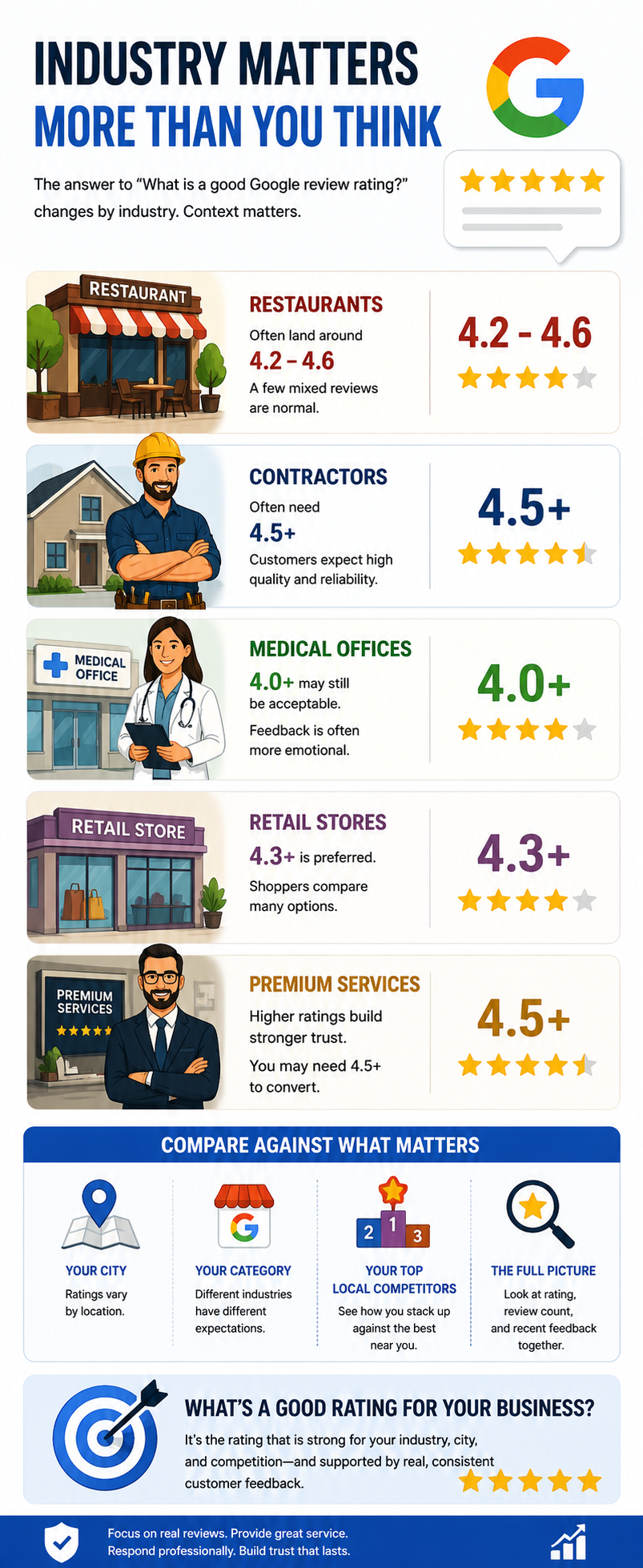
Another thing the live article gets right is that the answer to what is a good Google review rating changes a little by industry. It currently gives examples like restaurants often landing around 4.2–4.6, contractors often needing 4.5+, medical offices where 4.0+ may still be acceptable, and retail stores where 4.3+ is preferred.
That means context matters.
For example:
- a restaurant may survive with a few more mixed reviews
- a contractor may need a cleaner, stronger score
- a medical office may be judged differently because people often leave more emotional feedback
- a premium service business may need a higher trust score to convert
So the best way to answer what is a good Google review rating for your business is to compare it against:
- your city
- your category
- your top local competitors
A number that looks decent in one industry may look weak in another.
A one-star increase in rating can lead to more clicks and higher sales.
Review Count Matters Too
This is one of the biggest campaign lessons in the article, and it should be pushed even harder.
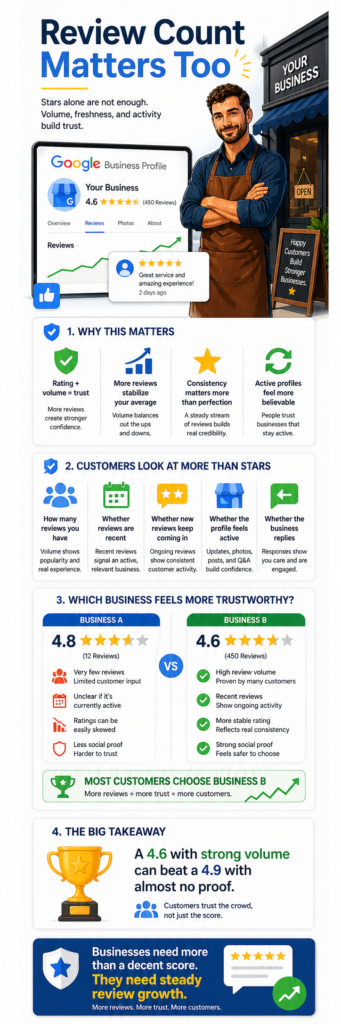
The live article says rating + volume = trust and gives the example of 4.8 stars with 12 reviews versus 4.6 stars with 450 reviews, noting that most customers trust the second option more. It also says consistency matters more than perfection and that more reviews stabilize your average.
That is huge.
Because what is a good Google review rating is never just about the stars.
how many reviews you have
whether reviews are recent
whether new reviews keep coming in
whether the profile feels active
whether the business replies
A 4.6 with strong volume can beat a 4.9 with almost no proof.
That is why businesses need more than a decent score. They need steady review growth.
Responding to reviews can boost customer trust—even if the review is negative.
What Customers Really Notice
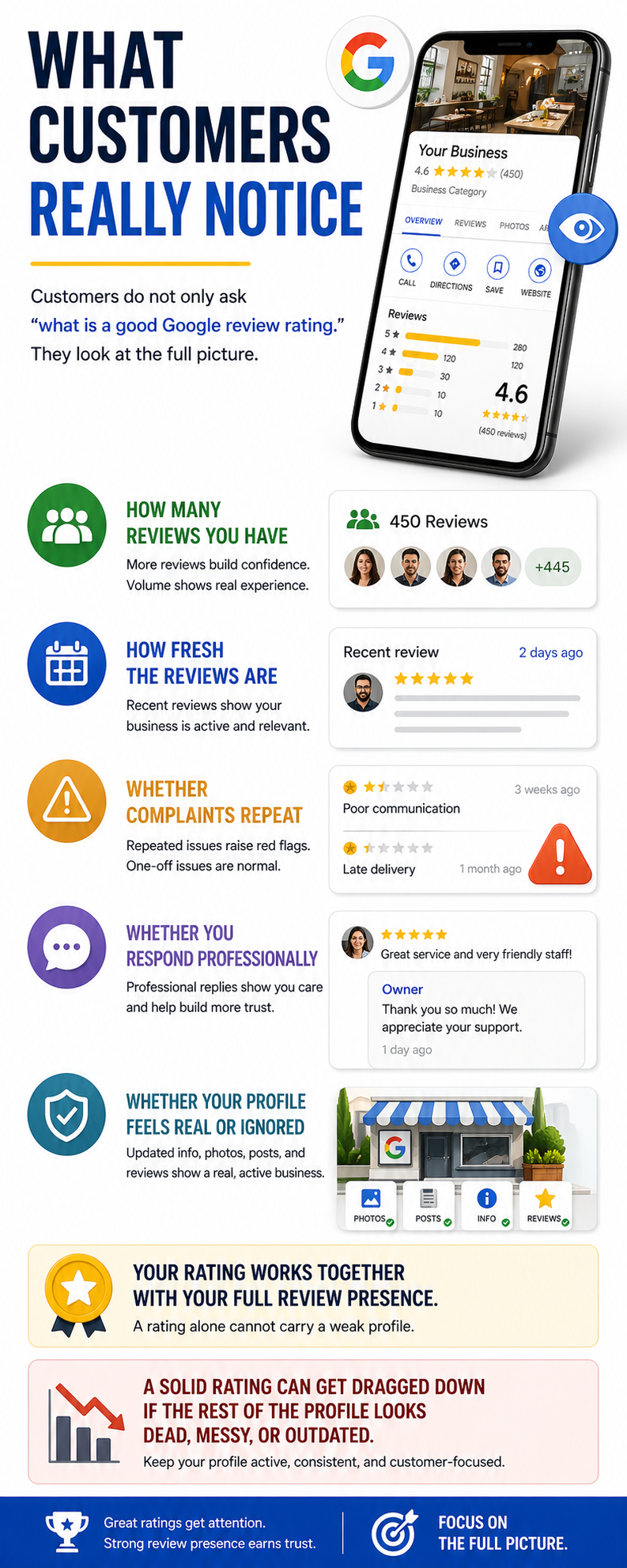
When customers look at your profile, they do not only ask what is a good Google review rating.
They also notice:
- how many reviews you have
- how fresh the reviews are
- whether complaints repeat
- whether you respond professionally
- whether your profile feels real or ignored
That means your rating works together with your full review presence.
A rating alone cannot carry a weak profile.
And a solid rating can get dragged down if the rest of the profile looks dead, messy, or outdated.
A steady flow of reviews looks more natural than getting many reviews all at once.
What Rating Scares Customers Away?
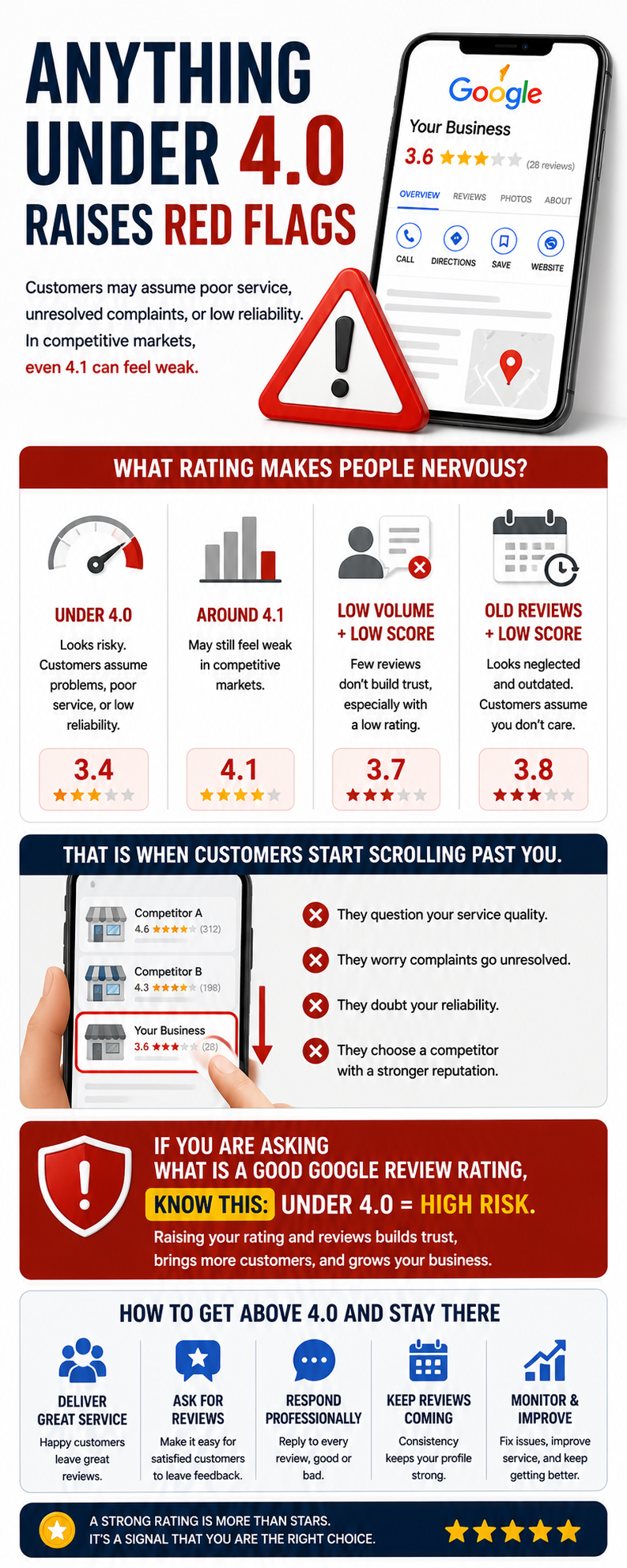
Anything under
4.0 raises red flags. It says customers may assume poor service, unresolved complaints, or low reliability, and that in competitive markets even 4.1 can feel weak.
That is important because business owners sometimes think:
“Well, 3.9 is almost 4.0, so maybe that’s fine.”
Not really.
If you are asking what is a good Google review rating, the flip side is this:
what rating makes people nervous?
Usually:
- under 4.0 looks risky
- around 4.1 may still feel weak in competitive markets
- low volume plus low score feels even worse
- old reviews plus low score make the business look neglected
That is when customers start scrolling past you.

How to Improve Your Google Review Rating
The live article already has a clean list here, and the core advice is right. It says to fix service gaps first, ask happy customers, respond to reviews, address complaints quickly, and stay consistent with review growth.


1. Deliver a Better Customer Experience
Before you chase more reviews, fix what is causing the bad ones.
If customers keep complaining about the same thing, the review problem is not just a review problem. It is a service problem.
2. Ask Happy Customers at the Right Time
The best time to ask is right after a good experience, when the customer still feels the value.
3. Respond to Reviews Professionally
This helps with trust, credibility, and future conversions. The live article already notes that engagement builds trust.
4. Handle Complaints Quickly
The article is right that solving issues fast can stop some problems from turning into 1-star reviews.
5. Keep Review Growth Ongoing
If improving your rating feels overwhelming, working with a review management service company can help you consistently collect feedback, respond to customers, and build a stronger online reputation.


Why This Matters for Business Owners
Here is the bigger campaign angle this article should push harder.
If customers are judging your business by its review rating, then your reviews are part of your sales process.
That means what is a good Google review rating is not just a nice SEO topic.
It connects to:
- how trusted your business looks
- whether people click your profile
- whether they visit your website
- whether they call you
- whether they choose you over somebody else
So if your profile is sitting at a weak rating, low review count, or stale review history, that can cost you business even if you do great work offline.
How a Google Review Management Service Helps
A Google review management service helps you do more than just hope your rating improves.

It can help your business:
- It can help your business:
- get more real customer reviews
- improve review consistency
- respond to negative reviews the right way
- stay active on your profile
- build trust with future customers
- protect your reputation over time
That is basically the case for review management right there.
You do not need perfection.
You need a system.
The Real Goal
The goal is not chasing a perfect 5.0, but building 4.5+ stars, steady monthly review growth, and professional responses.
That is the right goal because it gives you:
- credibility
- consistency
- stronger local trust
- better customer confidence
- a more stable profile over time
So if you are asking what is a good Google review rating, the best answer is not:
“Whatever gets the highest number.”

FAQ
Is 4.2 a good Google rating?
Yes, but the live article notes that improving to 4.5+ increases trust.
How many reviews do I need?
There is no magic number. The article says consistent growth matters most.
Does Google rating affect SEO?
The live article says yes, that strong ratings and engagement support local visibility.
Can I remove bad reviews to improve rating?
Only if they violate Google policy, which the article also states.
Is a 5.0 rating realistic?
It can happen, but the article notes that balanced ratings often look more authentic.

Conclusion
If you have been asking what is a good Google review rating, here is the honest answer:
For most small businesses, a strong target is 4.5 stars or higher, backed by real review volume, fresh feedback, and professional responses.
That is what helps a business look trusted.
Because people are not just judging the number. They are judging the full picture. They are looking at how many reviews you have, how recent they are, whether the feedback feels real, and whether your business actually responds.
That is why a good Google review rating is not just about looking nice on a screen. It is about helping customers feel safe choosing you.
And if your rating is weak, stale, or unsupported by enough reviews, that can quietly cost you clicks, calls, and sales.
So do not chase perfection.
Build consistency.
Build credibility.
Build a profile that looks active, real, and worth trusting.
If your business needs help improving review quality, increasing review volume, and turning your reputation into more customer action, now is the time to stop guessing and start managing it with purpose.

Want to improve your Google rating without cutting corners?
Our Google review management service helps small businesses get more 4-star and 5-star Google reviews, respond professionally, and build a stronger reputation that leads to more clicks, more calls, and more customers.
Book your free strategy call today and start building a stronger review profile.